


Brian Blase, Ph.D., is the President of Paragon Health Institute. Brian was Special Assistant to the President for Economic Policy at the White House’s National Economic Council (NEC) from 2017-2019, where he coordinated the development and execution of numerous health policies and advised the President, NEC director, and senior officials. After leaving the White House, Brian founded Blase Policy Strategies and served as its CEO.
ACA Enrollment Level-Setting and New Paragon Work on Hospital Policy

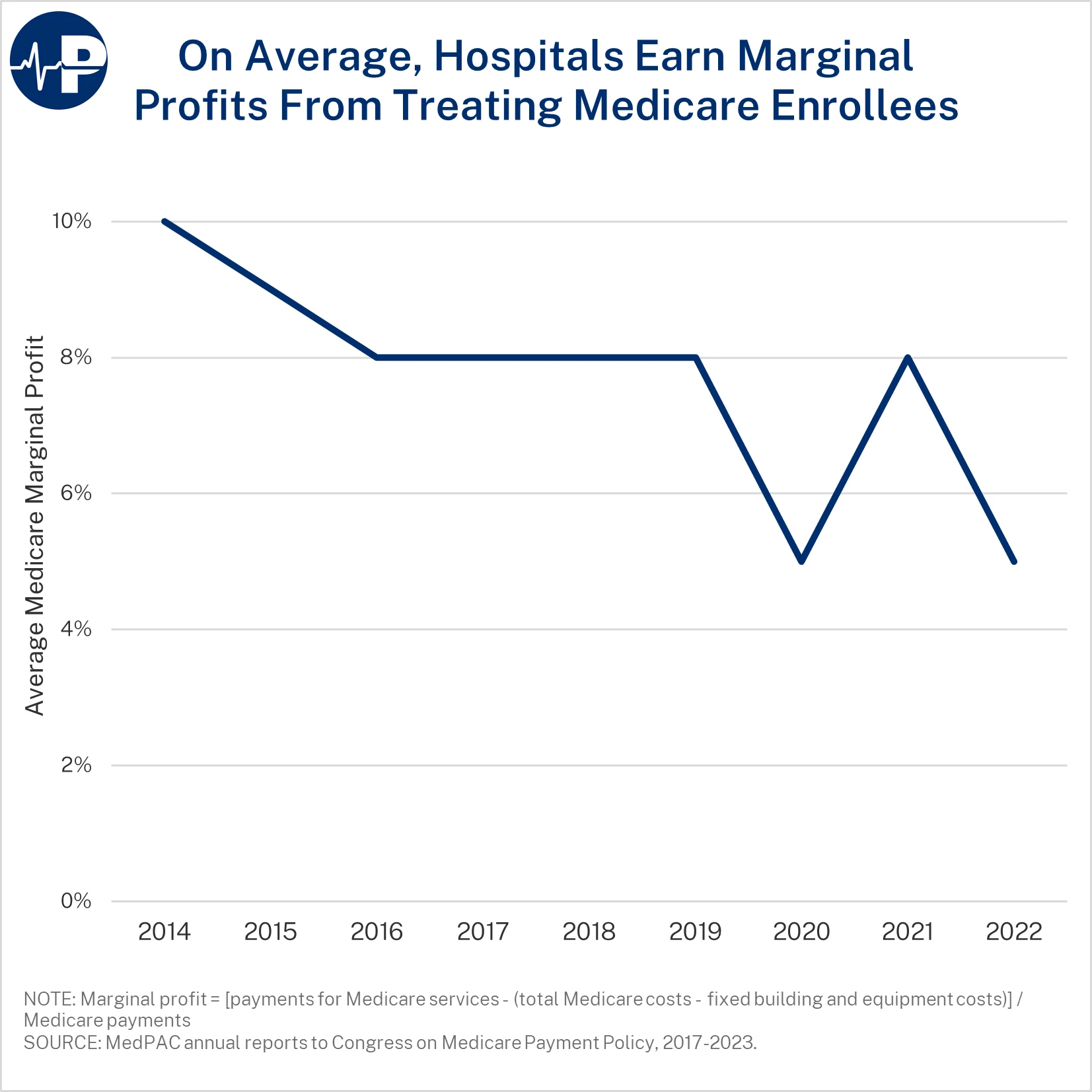
Today’s newsletter begins with two pieces on Affordable Care Act (ACA) enrollment: new data showing that improper enrollment is higher than we originally estimated and a response to a misleading New York Times story. The remainder focuses on hospitals: a review of last week’s Ways and Means hearing, a new Prognosis on physician-owned hospitals, and a Paragon PIC showing that hospitals earn marginal profits on Medicare patients.
Continuing our series of events with exceptional guests, on Monday at noon in the Capitol Visitor’s Center, I will moderate a discussion with the director of the Congressional Budget Office (CBO) Phillip Swagel and key members of his team on Medicare, Medicaid, and Affordable Care Act expenditures. The event is open to the public, and you can register for it here.
Improper ACA Enrollment Higher Than We Originally Estimated
Updated Census Bureau data confirms that improper enrollment in the Obamacare exchanges is even higher than our original estimates. Our estimates compared ACA sign-ups reporting income between 100 and 150 percent of the federal poverty level (FPL) with Census data on the population in that range who were between the ages of 19 and 64 and were not enrolled in Medicare or Medicaid. Critics objected to using older Census data trended forward, but updated data show that improper enrollment is higher—5.1 million and 6.5 million enrollees in 2024 and 2025, respectively, up from 4.8 million and 6.4 million in our original estimates.
We are in the process of updating our annual Great Obamacare Enrollment Fraud series. One key finding: 27 percent of all ACA sign-ups in 2026 were improperly enrolled—about the same level as after the 2025 open enrollment period. These findings reinforce concerns raised by CMS Administrator Dr. Mehmet Oz at last week’s Paragon event: without stronger eligibility verification and program integrity, improper enrollment will remain a defining feature of the ACA exchanges.
New York Times Piece on ACA Enrollment Misses the Mark
A May 1 New York Times story on declining Obamacare enrollment received significant attention but presents a misleading picture by omitting critical context—particularly the scale of subsidies and the extent of improper and phantom enrollment. Here is the key context omitted by the Times that is essential for understanding ACA enrollment trends:
- More than nine in ten ACA enrollees have income below four times the FPL, making them eligible for substantial federal subsidies.
- For the median enrollee, subsidies cover 94 percent of premiums. The subsidies limit what enrollees pay—so almost all premium growth over time has been paid by taxpayers.
- Improper and phantom enrollment are now a defining feature of the ACA exchanges. There was no mention of Paragon’s work quantifying improper enrollment, which found more than 6 million improper enrollees and between 3 million and 4 million phantom enrollees—individuals enrolled in coverage who are unaware of their enrollment, have other coverage, or are fictional.
- The exchanges lack basic program integrity, evidenced by the Government Accountability Office successfully enrolling 23 of 24 fictitious applications in fully subsidized plans.
- The Congressional Budget Office estimated 2.3 million improper enrollees in just the 10 states that did not expand Medicaid, and only among those who overestimated income to qualify for subsidies.
- The Department of Justice successfully prosecuted three major fraud schemes, each totaling more than $100 million in improper subsidy payments involving unscrupulous enrollment intermediaries who falsified information.
- Unauthorized enrollment and plan switching are real problems, evidenced by 850 brokers being suspended in 2024 and nearly 2 million individuals simultaneously enrolled in both ACA exchange coverage and Medicaid.
- Enrollment in the ACA exchanges is well above historical levels. From 2014 through 2019, average monthly enrollment in the exchanges was 18 percent below open enrollment sign-ups—indicating that some enrollees drop their coverage over time. Assuming a similar pattern this year—after the expiration of enhanced COVID subsidies—means that average enrollment in 2026 will be about 19 million. A 19 million enrollee market would be 90 percent higher than the pre-COVID average.
Taken together, these realities are not peripheral—they are central to understanding ACA enrollment trends. Ignoring them does not simply leave out nuance; it leads to a deeply incomplete and potentially misleading account of what is happening in the exchanges today.
House Ways & Means Hearing Affirms Paragon Research on High Hospital Prices
On April 28, the House Ways and Means Committee held a hearing with health system CEOs, highlighting the role of hospitals as the primary driver of health care unaffordability. It was striking that leaders from both parties were critical of the status quo and saw hospitals as a factor in rising health care prices.
As discussed in our recent study, government policy has resulted in major advantages for hospitals, including protection from competition and payment policies and subsidy programs that enable inefficient cost structures. As a result, many hospital systems have become consolidated mega-systems that raise prices, lobby to suppress their competition, rely on government policies that reward inefficiency, and allow administrative costs and CEO and executive salaries to grow unsustainably.
Chairman Jason Smith went even further, documenting numerous abuses and charging hospitals with “borderline extortion.” He cited examples like a $300,000 snakebite treatment, a $13,000 CT scan, and facility fees that lead to much higher bills for the same services in hospital outpatient settings than in independent practices.
Among other important topics, the hearing covered how hospitals benefit from Medicare’s payment systems to earn higher fees for services that can be performed at the same quality in lower-cost facilities; how they profit from a drug-purchasing program (340B) designed to help poor, uninsured patients; and how hospital mergers raise prices without improving quality. I applaud Chairman Smith for holding this important hearing, as high and rising hospital prices are the number one reason that health care is unaffordable for so many Americans.
Permitting Physician-Owned Hospitals to Fully Compete
As detailed in our Hospital Cost Crisis study, government policy has played a central role in driving hospital consolidation, suppressing competition, and enabling rising prices. As Katherine Hall makes clear in a new Prognosis, restrictions on physician-owned hospitals (POHs) are a clear example and should be done away with.
Prior to the Affordable Care Act (ACA), POHs were an emerging source of competition, offering an alternative to large hospital systems. The ACA effectively shut down that competition by prohibiting Medicare payments for new POHs and existing POHs that expand. Given Medicare’s outsized role in the American health sector, this effectively stopped the growth of POHs—acting as a de facto barrier to entry in a market heavily shaped by federal payment systems.
These restrictions were justified by concerns about self-referral, cherry-picking of profitable patients, and harm to community hospitals. However, the evidence does not support these claims. Research consistently finds that POHs deliver care of equal or higher quality and often at lower cost than traditional hospitals. Moreover, the concerns raised about physician incentives are not unique to POHs—hospital-employed physicians can face similar incentives to refer within their systems.
Meanwhile, hospital consolidation has accelerated dramatically since the ACA’s passage in 2010. Large systems now dominate most markets, physician employment by hospitals has surged, and prices are significantly higher in concentrated markets. By limiting physician ownership, the ACA removed a potential competitive check on this consolidation and eliminated an organizational model that allowed physicians to remain independent.
Lifting the ACA’s restrictions on POHs would restore competition, expand patient choice, and put downward pressure on prices. More broadly, it would help correct a policy-driven imbalance that has favored large hospital systems at the expense of efficiency and affordability.
Hospitals Earn Marginal Profits Treating Medicare Patients
As John R. Graham wrote in the Hospital Cost Crisis study, hospitals consistently earn positive marginal profits from treating Medicare patients, despite frequently claiming losses. The difference lies in accounting: hospitals emphasize operating margins, which allocate fixed costs to Medicare patients and show losses, while marginal profit reflects the reality that treating additional Medicare patients generates income because payments exceed variable costs. This dynamic helps explain why hospitals continue to serve Medicare beneficiaries while arguing that the program underpays them. Medicare’s payment system—based on a “market basket” that largely accepts hospitals’ reported costs—also weakens incentives to reduce fixed costs, contributing to persistent inefficiency and reinforcing the cost structures highlighted in our broader hospital cost research.
Recent Newsletters


Subscribe
Sign up now for your health policy updates.