


The American Hospital Association recently criticized the claim in Paragon’s new study, The Hospital Cost Crisis: How Government Policies Drive Consolidation, Undermine Competition, and Fuel Soaring Prices, that Medicare is consistently profitable for hospitals. Hospitals would not have continued to treat Medicare patients for 60 years if doing so consistently resulted in losses.
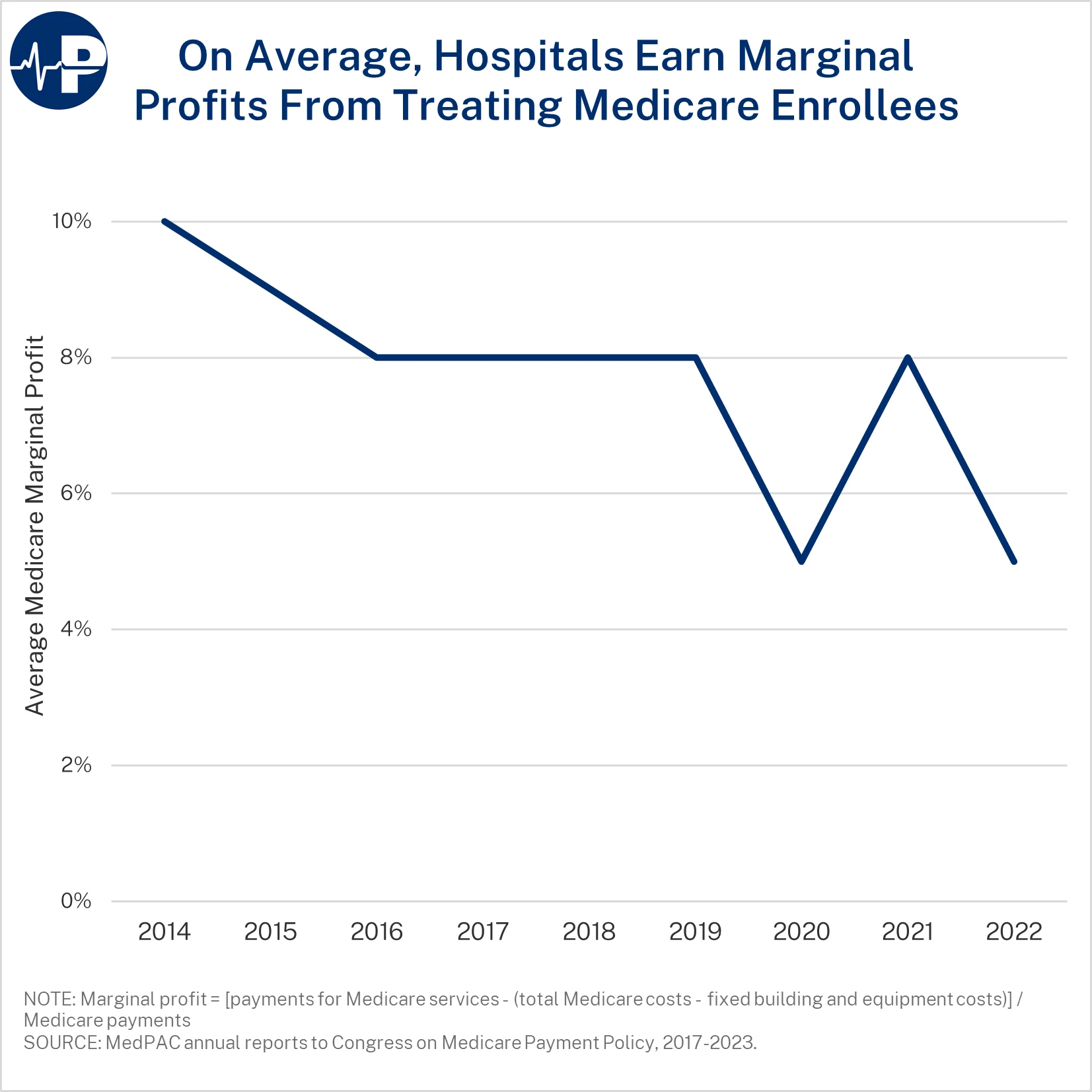
Hospitals’ Medicare marginal profit is consistently positive, as shown in this PIC. The Medicare marginal profit exceeded 10 percent in 2014 and was about 9 percent in 2015. From 2016 through 2019, hospitals’ Medicare marginal profit was 8 percent. In 2020, Medicare marginal profit dropped to 5 percent, returned to 8 percent in 2021, dropped to 5 percent again in 2022, and remained positive in 2023 (the most recent year for which it is reported).
Hospitals emphasize a different financial metric—operating margin—that often shows losses. This second measurement allocates hospitals’ heavily inflated fixed costs to Medicare patients, resulting in operating losses from Medicare.
To understand the difference, let’s look at an average U.S. hospital. The hospital receives gross payments of $100 million annually from Medicare claims, having treated 5,000 Medicare patients with average gross revenue of $20,000 per patient. The hospital submits claims with charges based on its costs. Most of these costs vary: These costs are only incurred when the hospital treats a Medicare patient. For the 5,000 patients treated, these costs add up to $90 million. The hospital’s marginal profit is $10 million, or 11 percent. In other words, Medicare patients contributed to overall profits for the hospital.
However, the hospital would incur substantial fixed costs even if it treated no Medicare patients. These costs are fixed no matter how many patients are treated and, in this example, total $22 million. When those fixed costs are allocated to Medicare patients, it results in operating costs of $112 million, and a loss of $12 million, or 12 percent. Needless to say, hospitals only highlight this latter measurement in their advocacy. There is nothing wrong with this measurement: It is standard business accounting. However, as an advocacy tool it leads to misguided policy conclusions.
Medicare payments change according to a market basket that largely accepts, rather than negotiates, hospitals’ total costs. This weakens incentives for hospitals to reduce fixed costs over the long term and likely helps explain why productivity gains have been so elusive in the hospital sector.