

Brian Blase, Ph.D., is the President of Paragon Health Institute. Brian was Special Assistant to the President for Economic Policy at the White House’s National Economic Council (NEC) from 2017-2019, where he coordinated the development and execution of numerous health policies and advised the President, NEC director, and senior officials. After leaving the White House, Brian founded Blase Policy Strategies and served as its CEO.
Debating a Government Shutdown & New AI Paper on Targeted Post-Market Surveillance
In this week’s newsletter, I discuss the ongoing debate in Congress about a potential government shutdown. I highlight the latest Paragon Pic, showcasing how taxpayers will still pay 80 percent of the ACA premiums for the average enrollee after the expiration of Biden’s COVID credits. I also briefly review an important new Paragon research paper about how we can get AI medical devices to market and ensure they are safe and effective for patients. And I conclude with a recommendation of a recent House hearing on nonprofit hospitals.
Debating a Government Shutdown
Last week, the U.S. House of Representatives passed a continuing resolution (CR) that would fund the government through November 21. However, Senate Democrats blocked its passage, meaning government funding for discretionary programs may lapse at the end of the month. Democrats have released an alternative CR that would repeal the health provisions of the One Big Beautiful Bill (OBBB) and permanently extend Obamacare subsidies that were designed to address the COVID pandemic.
As Paragon has discussed, the OBBB curbs Medicaid waste and promotes accountability. During the Biden administration, projected Medicaid spending rose by $1.2 trillion over 10 years. The OBBB restores the program back on a more sustainable trajectory, reduces corporate welfare in the program, and refocuses Medicaid on the truly vulnerable. OBBB’s commonsense policies include preventing multiple states from enrolling the same individual in Medicaid and implementing community-engagement requirements for working-age, able-bodied adults who seek Medicaid. The Democrats’ alternative CR would also eliminate limits on financial scams that drive corporate welfare and the cap on Medicaid reimbursing providers more than Medicare rates. Over the past few years, this has become an increasingly common practice where states pay Medicaid two to three times what Medicare reimburses for the care of seniors.
In addition, Democrats’ CR would permanently extend the enhanced premium tax credits (PTCs) for Obamacare exchange plans. Democrats created these credits as a temporary pandemic measure. The COVID credits allowed many individuals to have their entire premiums subsidized by the federal government. Individuals do not directly see the subsidy because it flows from the government to health insurers. These “zero-dollar premium” plans have become a breeding ground for fraud. Our research reveals 6.4 million improper Obamacare exchange enrollees in 2025 at a cost of $27 billion.
Many leading congressional Democrats are suggesting that all the Obamacare exchange subsidies are set to expire after this year. This is patently false: the original Obamacare subsidies are permanent. And the permanent Obamacare subsidies are generous and expensive for taxpayers. When the COVID credits expire, most enrollees would have to pay less than $20 a week for coverage—with the subsidy covering the vast majority of the total premium. By intentionally conflating these with temporary COVID enhancements, some lawmakers are parroting the misleading rhetoric of outside special interests—insurers and advocacy groups—who profit from inflated subsidies while deceiving Americans about coverage risks. In a recent newsletter, I made the case for permitting the COVID credits to expire.
Taxpayers Pay the Lion’s Share of ACA Premiums
This week’s Paragon Pic shows how taxpayers bear the vast majority of the premium cost for the typical enrollee and how the taxpayer’s share of the cost has increased significantly over time. Specifically, the Pic shows the enrollee and taxpayer share of the cost for a benchmark ACA premium for a 50-year-old at twice the federal poverty level (roughly the age and income of the average ACA enrollee). The orange amount is the enrollee share, and the navy amount is what the federal government covers.
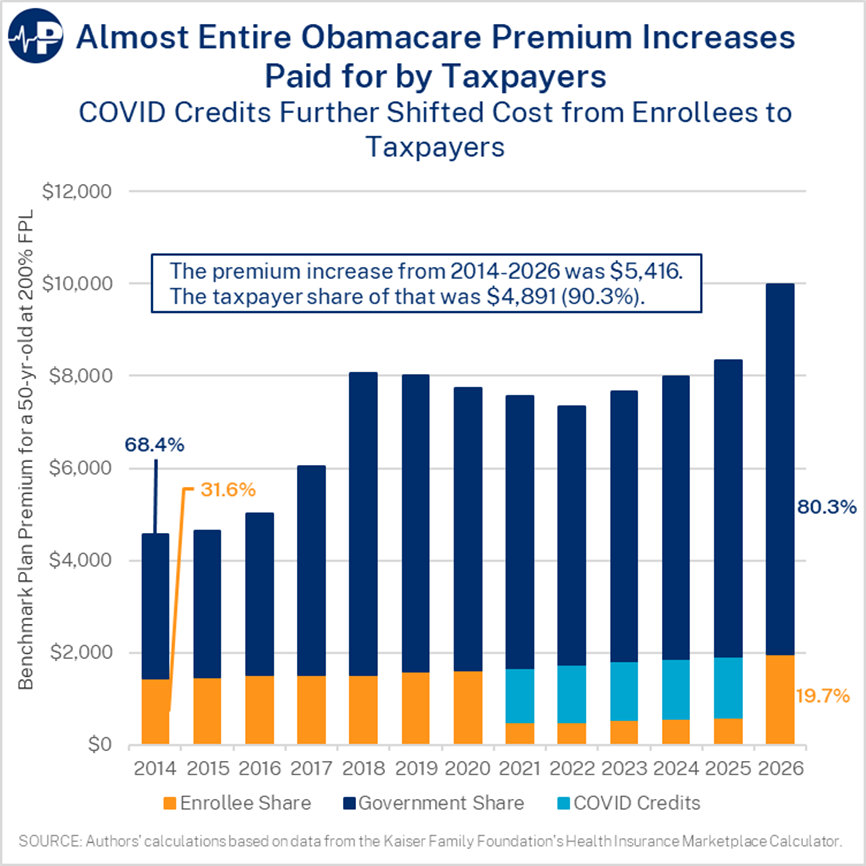
In 2014, taxpayers covered 68 percent of costs. From 2014 to 2020, the total premium increased from about $4,500 to $8,000. The enrollee amount stayed almost flat during this period, given Obamacare’s subsidy structure, so taxpayers bore almost the entire cost of premium increases. By 2020, taxpayers covered 80 percent of the total premium—a significant increase from Obamacare’s first year.
After this year, the temporary COVID credits are scheduled to expire. But the underlying Obamacare subsidy will still cover more than 80 percent of the typical enrollee’s premium.
Targeted Post-Market Surveillance: The Way Toward Responsible AI Innovation in Health Care
Artificial intelligence (AI) holds enormous promise in health care, but its potential is shadowed by a growing concern about output unpredictability. Output refers to what an AI device’s functionality produces, including an illness prediction, a diagnosis, or a treatment recommendation. Given AI’s reliance on complex statistical models and training data, identical inputs can yield different outputs in certain AI devices. This unpredictability raises valid patient safety concerns. But calls for heavier regulation could endanger not only medical AI innovation, but the nation’s AI leadership.
A new Paragon research paper by Paragon’s Kev Coleman and Michael Pencina of Duke University proposes an oversight model that balances safety, innovation, and practicality through postmarket surveillance that targets only those AI medical devices at risk for unpredictability.
Current FDA review processes were largely built for physical medical devices and conventional software. Moreover, while the FDA does have some authority for postmarket surveillance, it lacks the resources to scale this oversight for the unique challenges posed by AI technology and has emphasized the need for public-private collaboration when monitoring AI post-deployment. To that end, Kev and Michael propose a two-pronged oversight framework for AI devices’ unpredictability risks.
- Periodic device revalidations for AI devices whose programming architecture does not cause irregular outputs but whose ongoing data analysis can change outputs over time. The revalidations leverage the device manufacturer’s original device testing data to contain costs.
- Performance monitoring where output unpredictability is integral to an AI device’s programming architecture and necessary for its functionality. In output monitoring, a secure network shared among health systems using the same AI product would flag concerning output patterns that may not reach the level of patient harm but signal increasing device unpredictability. Since the output data is anonymous, manufacturers and health systems could jointly investigate whether an anomalous output reflects a broader trend across multiple systems or a deployment issue at a specific site.
This proposed framework would allow the U.S. to continue its health AI leadership, improve patient safety in an area where existing FDA processes are inadequate, and encourage market adoption through a design that is low-cost, non-disruptive, and scalable.
Congress Scrutinizing Nonprofit Hospitals
On September 16, the House Ways and Means Committee’s Oversight Subcommittee, chaired by David Schweikert, held an important oversight hearing, “Virtue Signaling vs. Vital Services: Where Tax-Exempt Hospitals are Spending Your Tax Dollars.” This hearing is welcome given the substantial role of nonprofit hospitals in the U.S. health sector, the large and growing prices at hospital systems, the massive government subsidies of hospitals, and the uneven quality of care at many systems. Many of the committee members expressed concerns with how some hospitals are using their tax-exempt funds—including for stadium naming rights, advertising, and DEI programs rather than direct patient care.
Christopher Whaley of Brown University testified, “Despite receiving more than $37 billion annually in federal and state tax benefits, nonprofit hospitals’ community benefit spending falls short by more than $25 billion per year relative to the value of their tax exemption.” At the same time, commercial hospital prices have increased more than three times the rate of inflation—and more than any other sector of the economy since 2000. “This growth,” added Whaley, “is largely driven by hospital mergers and vertical integration, which raise prices without improving quality and strain affordability for patients, employers, and taxpayers.”
Ge Bai, one of Paragon’s public advisors, also testified. Ge noted that “nonprofit hospitals, as a group, fall short of for-profit hospitals in providing the two largest components of community benefit—charity care and Medicaid shortfalls—despite the tax benefits they receive.”
According to Ge, the “tax-exempt status also gives nonprofit hospitals a competitive edge against independent practices, for-profit hospitals, and other facilities, and creates incentives for them to engage in vertical and horizontal consolidation.” Ge makes several excellent policy recommendations, including closing the dual-classification loophole (which allows urban hospitals to receive funds intended for rural hospitals); improving transparency of nonprofit tax reporting; removing anticompetitive regulations like Certificate of Need laws; and funding patients directly.
Recent Newsletters
Subscribe
Sign up now for your health policy updates.