


Brian Blase, Ph.D., is the President of Paragon Health Institute. Brian was Special Assistant to the President for Economic Policy at the White House’s National Economic Council (NEC) from 2017-2019, where he coordinated the development and execution of numerous health policies and advised the President, NEC director, and senior officials. After leaving the White House, Brian founded Blase Policy Strategies and served as its CEO.
American Voters Want Commonsense Medicaid Reforms

In today’s newsletter, I discuss some of the results from the first public opinion survey that Paragon has ever commissioned. Phil Klein, the editor of National Review Online, discussed the survey here. I then highlight Paragon’s research, done jointly with the Economic Policy Innovation Center, on California’s Medicaid money laundering scheme that led to the state using federal dollars to dramatically expand Medicaid for illegal immigrants and to eliminate the asset test for Medicaid.
Americans’ Support for Medicaid Reforms is High
Congress is considering options to reform Medicaid. In anticipation of this moment, Paragon has spent years developing policy solutions to fix Medicaid and improve Americans’ well-being. We recently commissioned a public opinion survey, representative of the American electorate, to gauge support for various reforms.
We tested the key proposal in our report, Medicaid Financing Reform: Stopping Discrimination Against the Most Vulnerable and Reducing Bias Favoring Wealthy States. We found that American voters overwhelmingly support it. Other proposals, which we will release next week to tackle the extensive money laundering tactics in Medicaid, are also widely supported.
Public Opinion Strategies surveyed a representative group of 1,000 registered voters from across the country. The results provide encouraging news for reformers committed to improving health programs serving the most vulnerable while making commonsense reforms.
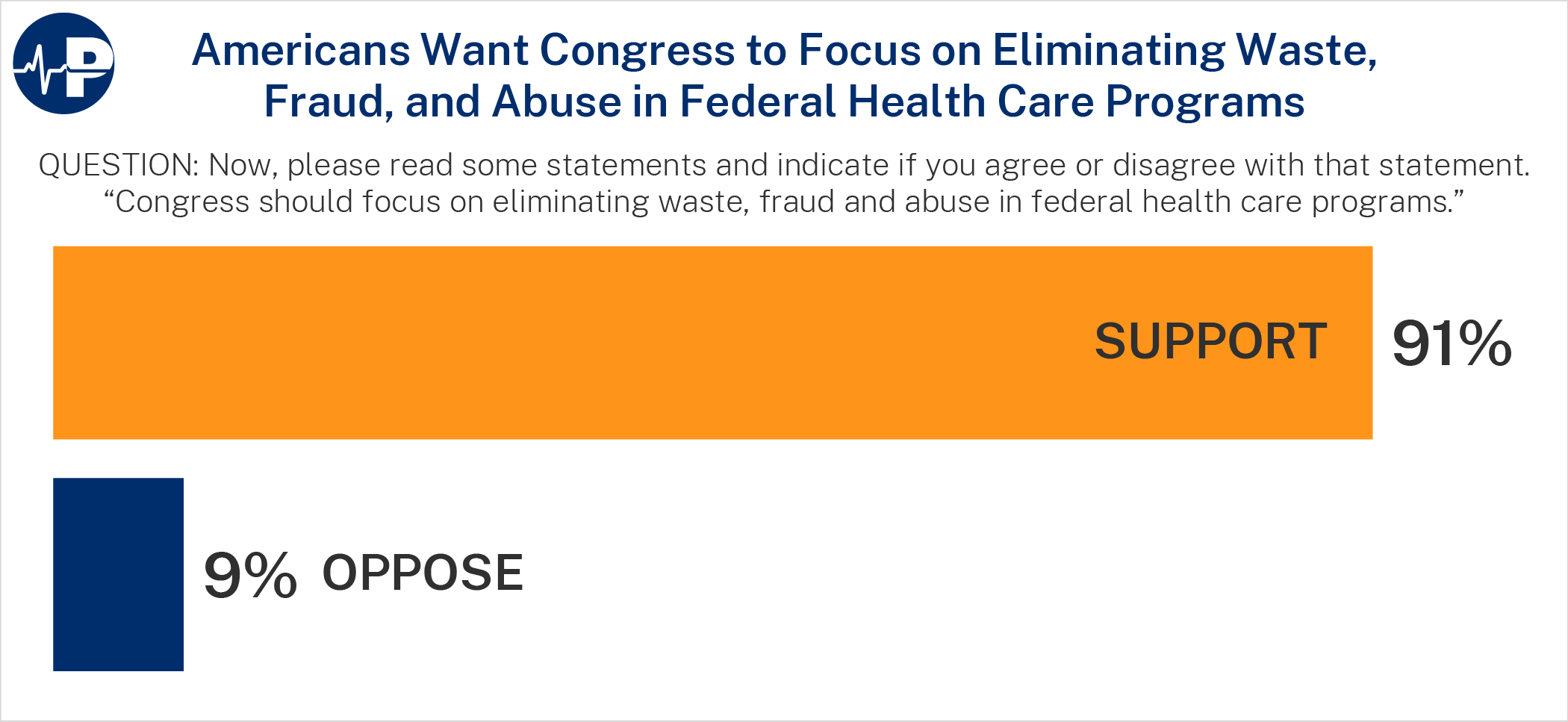
Americans across the political spectrum agree that Congress must crack down on waste, fraud, and abuse in federal health care programs. More than nine-in-ten voters support Congress targeting wasteful, fraudulent, and abusive government health care spending—97% of Republicans, 91% of independents, and 83% of Democrats.
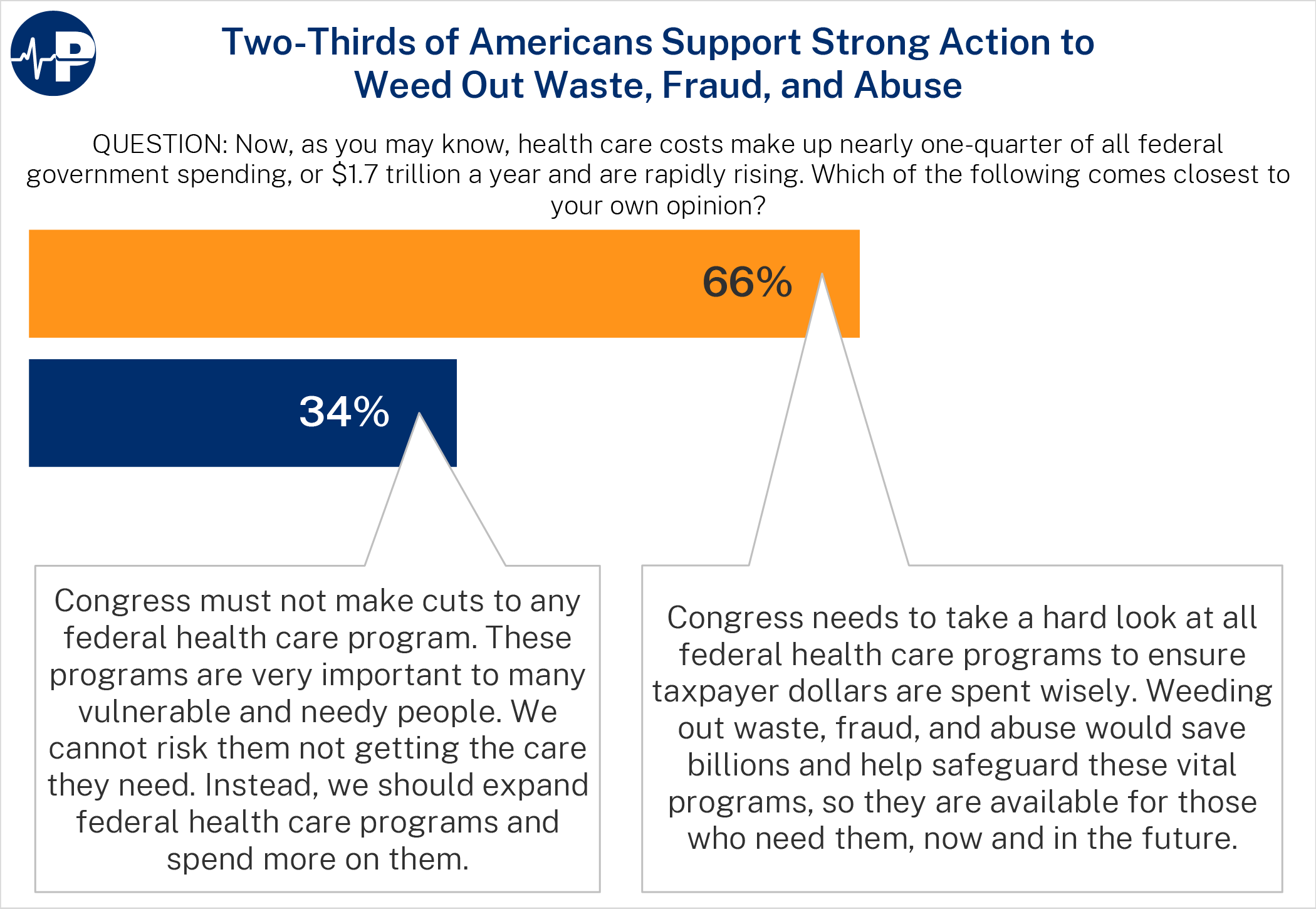
Twice as many Americans say that “Congress needs to take a hard look at all federal health care programs to ensure taxpayer dollars are spent wisely” than say that “Congress must not make cuts to any federal health care programs.”
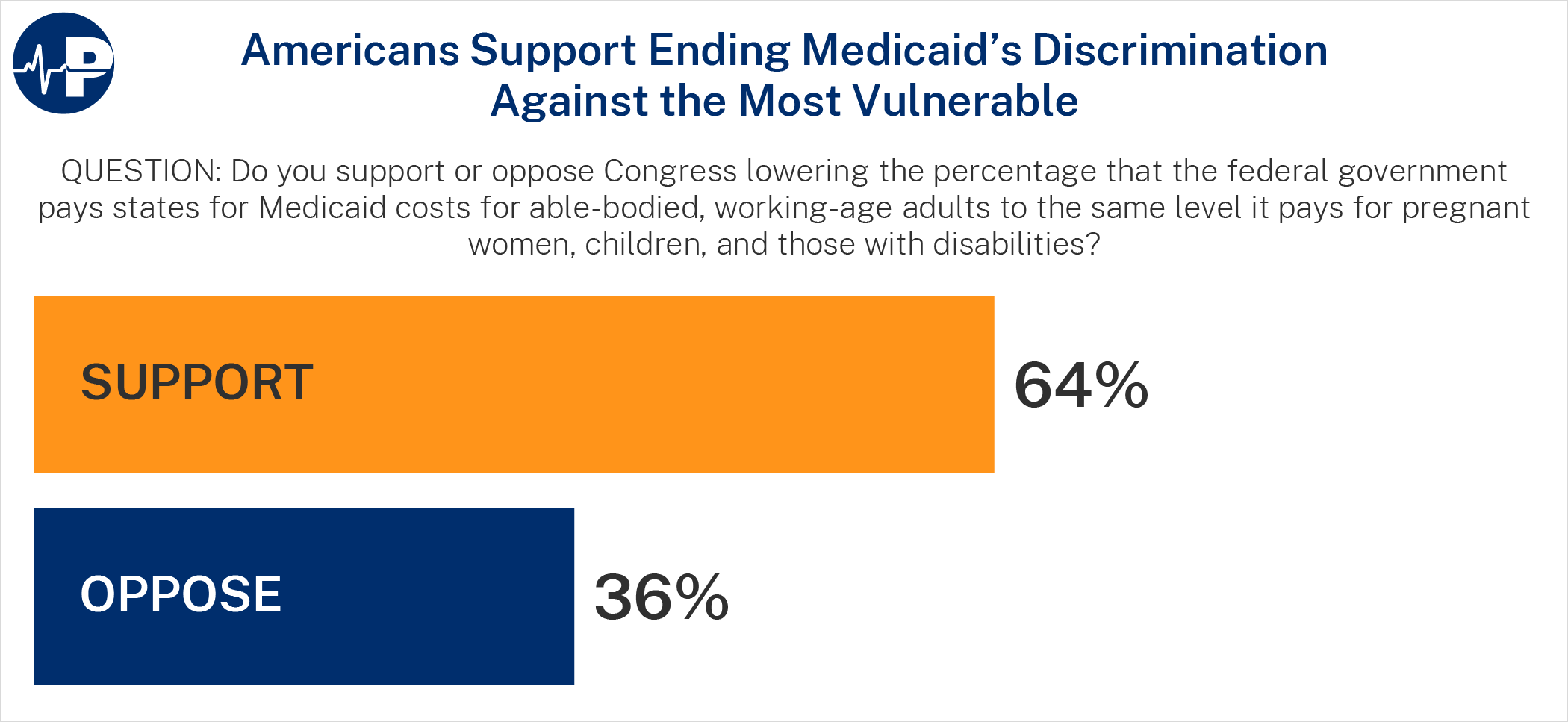
One of the most perverse features of federal Medicaid policy is that Washington reimburses a much higher percentage of state spending on able-bodied, working-age adults than it reimburses for children, pregnant women, seniors, and the disabled. Ending that disparity is the right public policy and popular with the American people. Nearly two-thirds of Americans support “Congress lowering the percentage that the federal government pays states for Medicaid costs for able-bodied, working-age adults to the same level it pays for pregnant women, children, and those with disabilities.” Health policy can be complex, but when framed in clear terms, voters overwhelmingly side with taxpayers financially supporting those who are less able to privately finance their medical services.
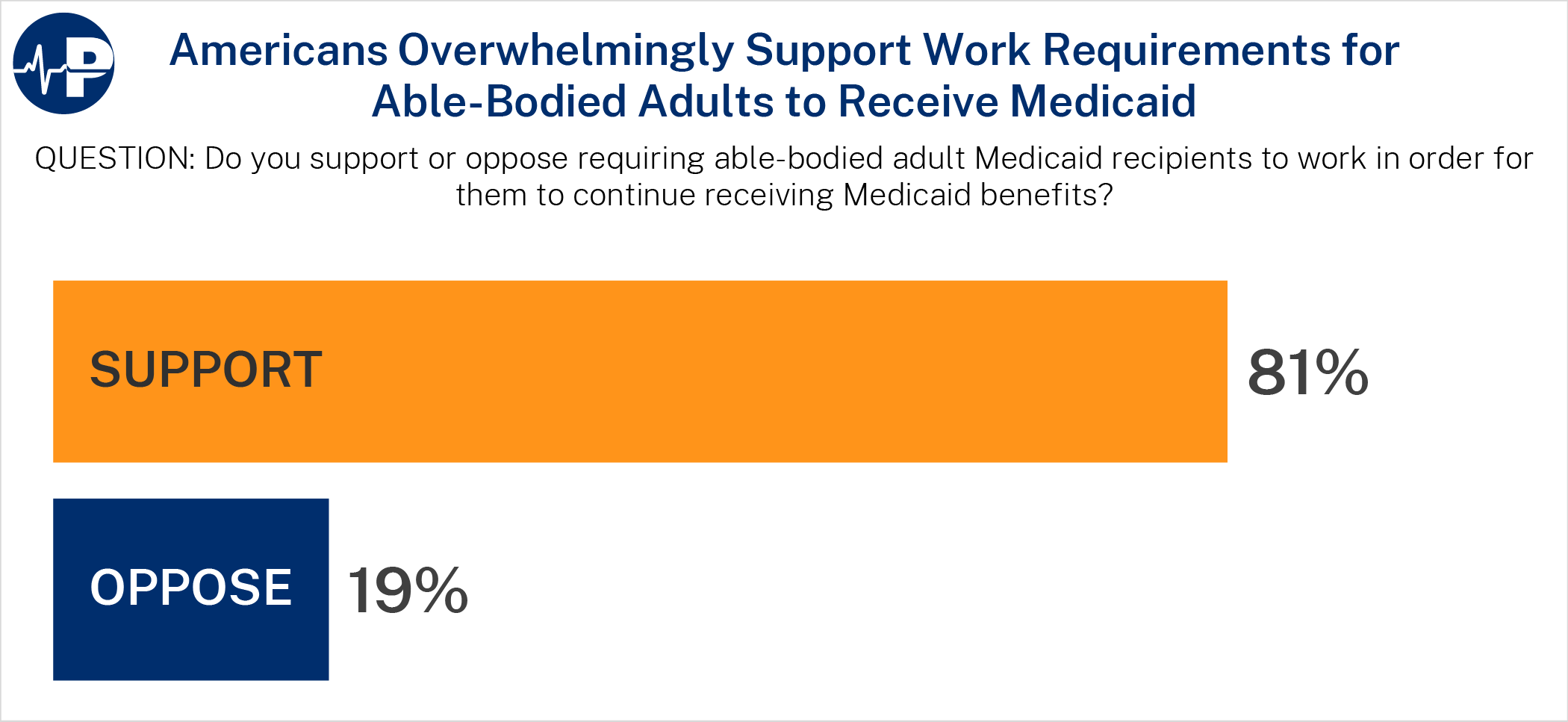
Americans resoundingly back work requirements for able-bodied Medicaid recipients. More than 80% of American voters support “requiring able-bodied adult Medicaid recipients to work in order for them to continue receiving Medicaid benefits,” with 90% of Republicans, 79% of independents, and 71% of Democrats in support.
The poll also assessed public opinion on key components of Medicaid financing schemes that benefit states and many health care providers, particularly those with more political power, but that raise costs for federal taxpayers. Paragon is releasing a paper next week that will thoroughly explain state Medicaid money laundering schemes and make recommendations for reining them in.
Using federal funds obtained through financing schemes, many states are now making Medicaid payments to providers that are now well above Medicare rates. 83% of American voters support “Congress requiring that Medicaid payments to health care providers cannot be higher than Medicare payments.”
Another common financing scheme involves states making much higher payments to government providers than private providers for the exact same services. The government providers kick a substantial portion of the excess payments back to the state. 77% of American voters support “Congress mandating that states can’t make larger Medicaid payments to government providers than they do to private ones.”
Americans support more stringent eligibility reviews to ensure only those who are eligible for Medicaid are enrolled. When given a choice, 64% of respondents said that the government should “ensure that only those who are eligible can enroll in Medicaid, even if that means some Americans are left without health insurance coverage.” Meanwhile, just 36% of respondents agree that “Medicaid should cover as many people as possible, even if that makes accessing care harder for those Medicaid was meant to serve – pregnant women, children, the disabled, and the elderly.” Paragon research has found that Medicaid expansion has reduced access for traditional recipients and harmed their health outcomes.
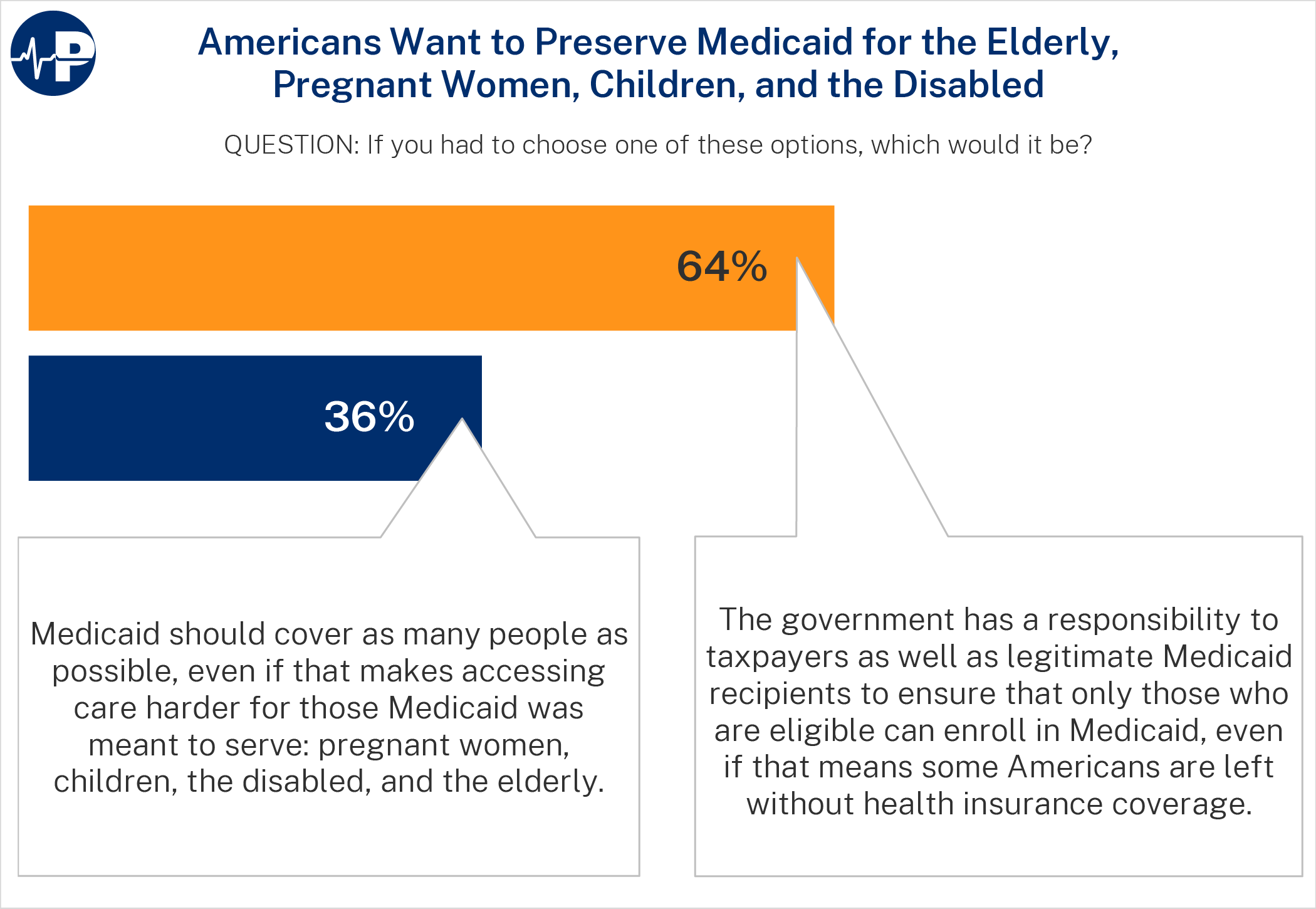
The results of our survey indicate that voters do not see a conflict between Medicaid reform and protecting the most vulnerable. Across party lines, Americans overwhelmingly support policies that prioritize children, pregnant women, seniors, and the disabled and that root out waste, fraud, and abuse. They want fiscal responsibility, not policies that strain resources and make it harder for the truly needy to access care. It turns out that lawmakers who champion smart reforms aren’t just making good policies — they’re aligning with the will of the voters.
California’s Money Laundering Scheme to Expand Medicaid for Illegal Immigrants and Preserve Inheritances for its Wealthiest Residents
In a recent policy brief, Paul Winfree and I exposed how California has effectively used money laundering tactics to finance Medicaid expansion for illegal immigrants—without the state being on the hook for any of the cost.
How California’s Money Laundering Scheme Works
California taxes insurance companies under the guise of increasing state Medicaid funding. But this is a financial shell game. The state collects the tax from insurers, then, as federal law requires, funnels the money right back to them in the form of higher Medicaid rates. This artificial money churn triggers federal matching funds, which then flow into California’s state coffers. The state effectively launders federal money through insurers, which are not harmed by the tax because they get every dollar back—and then some—through higher payments. The result: California uses federal dollars—rather than state money—to cover illegal immigrants under Medi-Cal.
Medicaid for the Rich
On top of this, California recently eliminated the asset test for Medicaid, meaning wealthy individuals can now qualify for taxpayer-funded nursing home care or home care services without spending down their own resources. Medicaid was designed as a safety net—not an inheritance protection program for the wealthy. But by removing eligibility safeguards, California is turning Medicaid into a universal entitlement.
The Bottom Line
California’s money laundering scheme is a blatant abuse of the joint federal-state Medicaid financing partnership. It results in a massive federal-to-state cash transfer that rewards financial scheming and accounting gimmicks at the expense of fiscal responsibility. The state bears no cost, insurers aren’t harmed, but federal taxpayers foot a large bill. All states use a variety of schemes to maximize federal Medicaid funding, but the insurer taxes are a particularly egregious money laundering scam. Congress and federal regulators should put an end to this legalized fraud before other states follow suit.
Recent Newsletters

Subscribe
Sign up now for your health policy updates.