


Paragon Health Institute Icon White
Paragon Pic

The Inflation Reduction Act Caused A Surge in Taxpayer Subsidies for Medicare Part D

2MS Medicare Part D Subsidies A0wUU000002HN0fYAG 01
Click the Pic to expand the image
Joe Albanese
Senior Policy Analyst at Paragon Health Institute

Joe Albanese is a Senior Policy Analyst with Paragon Health Institute. He comes to Paragon with over six years of federal and nonprofit public policy experience.

Drew Gonshorowski
Senior Research Fellow at Paragon Health Institute

Drew Gonshorowski is a Senior Research Fellow at Paragon Health Institute. He brings a decade of experience conducting quantitative research and building models examining health policy and entitlement programs.

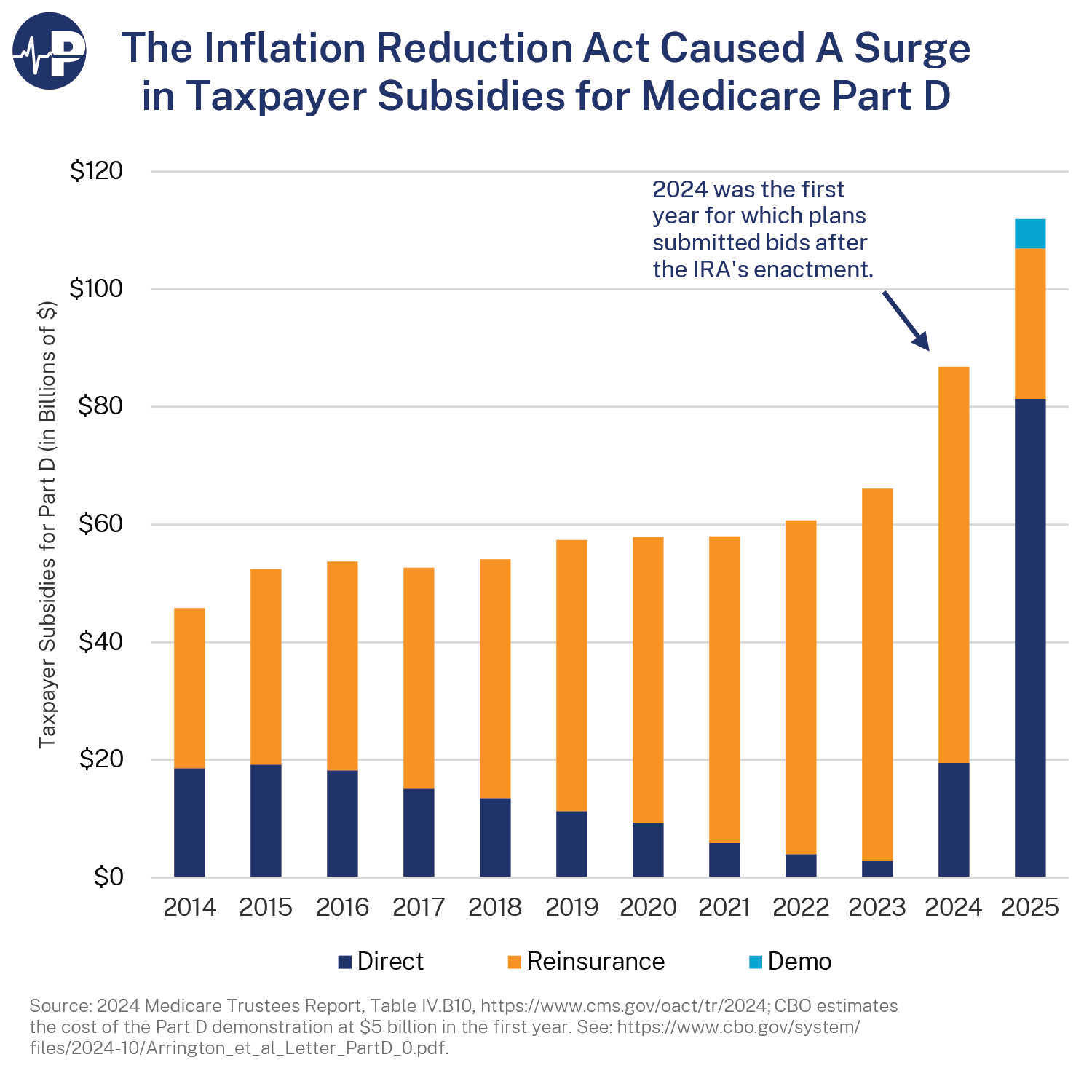
Prescription drug costs are a key election year concern for Americans. The redesign of the Medicare Part D prescription drug program under the 2022 Inflation Reduction Act was supposed to reduce such costs for seniors and the federal government. This week’s Pic shows that, in actuality, these policies have actually significantly increased the program’s costs.

The IRA redesigned the Part D benefit to include a relatively low $2,000 annual cap on out-of-pocket expenses and to shift which costs are borne by beneficiaries, drug plans, drug manufacturers, and the federal government. The federal government (that is, taxpayers) primarily subsidizes the costs of Part D coverage through “direct” subsidies, which are calculated as a percentage of average plan bids (essentially the plans’ cost of providing coverage) for each contract year, and “reinsurance” subsidies, which represent the federal government’s share of costs in the catastrophic phase of the benefit. Under Part D redesign, Medicare covers a much smaller share of catastrophic costs. However, shifting those costs onto plans has led them to increase their bids, thereby significantly increasing the federal government’s direct subsidies, far outweighing the reduction in reinsurance subsidies.

The IRA was enacted after plans had already submitted 2023 bids, so 2024 was the first year plans could react to the new costs of the redesign taking full effect in 2025. After years of consistent decreases, the average bid for a standalone Part D plan rose from $34.71 in 2023 to $179.45 in 2025 (a 417 percent increase). According to the Medicare Trustees, direct subsidies will increase from $2.8 billion in 2023 to $81.4 billion in 2025 . The total amount of both direct and reinsurance subsidies will increase from $66.1 billion in 2023 to $106.9 billion in 2025 (a 69 percent increase).

Typically, higher plan bids translate into higher premiums. To avoid a premium hike weeks before the November election, the Biden administration announced a last-minute extralegal “demonstration” program to provide further subsidies to plans. The demonstration is intended to last for three years and is expected to cost over $5 billion in 2025 alone.

While average premiums in 2025 are down, the number of Part D plans is also falling by almost a quarter, as the program’s growing costs already convinced many insurers to scale back their offerings.

This outcome highlights the massive gap that often exists between the intentions of policymakers and the consequences of their actions. The goal of the IRA was to shift costs away from the Medicare program and its beneficiaries onto Part D plans. But the result has been a significant increase in the subsidies that taxpayers pay to insurance companies. Even with the temporary reprieve from higher drug premiums, this policy has left seniors with fewer coverage options. The old adage about free lunches holds true: shifting costs elsewhere does not eliminate them – and in this case, it increased them.


2MS Medicare Part D Subsidies A0wUU000002HN0fYAG 01

Prescription drug costs are a key election year concern for Americans. The redesign of the Medicare Part D prescription drug program under the 2022 Inflation Reduction Act was supposed to reduce such costs for seniors and the federal government. This week’s Pic shows that, in actuality, these policies have actually significantly increased the program’s costs.

The IRA redesigned the Part D benefit to include a relatively low $2,000 annual cap on out-of-pocket expenses and to shift which costs are borne by beneficiaries, drug plans, drug manufacturers, and the federal government. The federal government (that is, taxpayers) primarily subsidizes the costs of Part D coverage through “direct” subsidies, which are calculated as a percentage of average plan bids (essentially the plans’ cost of providing coverage) for each contract year, and “reinsurance” subsidies, which represent the federal government’s share of costs in the catastrophic phase of the benefit. Under Part D redesign, Medicare covers a much smaller share of catastrophic costs. However, shifting those costs onto plans has led them to increase their bids, thereby significantly increasing the federal government’s direct subsidies, far outweighing the reduction in reinsurance subsidies.

The IRA was enacted after plans had already submitted 2023 bids, so 2024 was the first year plans could react to the new costs of the redesign taking full effect in 2025. After years of consistent decreases, the average bid for a standalone Part D plan rose from $34.71 in 2023 to $179.45 in 2025 (a 417 percent increase). According to the Medicare Trustees, direct subsidies will increase from $2.8 billion in 2023 to $81.4 billion in 2025 . The total amount of both direct and reinsurance subsidies will increase from $66.1 billion in 2023 to $106.9 billion in 2025 (a 69 percent increase).

Typically, higher plan bids translate into higher premiums. To avoid a premium hike weeks before the November election, the Biden administration announced a last-minute extralegal “demonstration” program to provide further subsidies to plans. The demonstration is intended to last for three years and is expected to cost over $5 billion in 2025 alone.

While average premiums in 2025 are down, the number of Part D plans is also falling by almost a quarter, as the program’s growing costs already convinced many insurers to scale back their offerings.

This outcome highlights the massive gap that often exists between the intentions of policymakers and the consequences of their actions. The goal of the IRA was to shift costs away from the Medicare program and its beneficiaries onto Part D plans. But the result has been a significant increase in the subsidies that taxpayers pay to insurance companies. Even with the temporary reprieve from higher drug premiums, this policy has left seniors with fewer coverage options. The old adage about free lunches holds true: shifting costs elsewhere does not eliminate them – and in this case, it increased them.
Related Research

No results found.
Joe Albanese
Senior Policy Analyst at Paragon Health Institute

Joe Albanese is a Senior Policy Analyst with Paragon Health Institute. He comes to Paragon with over six years of federal and nonprofit public policy experience.

Drew Gonshorowski
Senior Research Fellow at Paragon Health Institute

Drew Gonshorowski is a Senior Research Fellow at Paragon Health Institute. He brings a decade of experience conducting quantitative research and building models examining health policy and entitlement programs.