Paragon Health Institute Icon White
Paragon Pic

Taxpayers Pay for Almost the Entire Increase in Obamacare Premiums

19MH PIC Almost Entire Obamacare Premium Inc A0wUU000005hNkrYAE
Click the Pic to expand the image
Brian Blase
President at Paragon Health Institute

Brian Blase, Ph.D., is the President of Paragon Health Institute. Brian was Special Assistant to the President for Economic Policy at the White House’s National Economic Council (NEC) from 2017-2019, where he coordinated the development and execution of numerous health policies and advised the President, NEC director, and senior officials. After leaving the White House, Brian founded Blase Policy Strategies and served as its CEO.

Mark Howell Headshot SMALLER V2

Mark Howell is a Research Assistant at Paragon Health Institute. He is passionate about advancing free-market solutions to improve healthcare access and affordability.

Obamacare, including its perverse subsidy design, continues to drive up insurance premiums and health care costs by largely insulating subsidized enrollees from premium increases. The premium increases for Affordable Care Act (ACA) plans are concealed from enrollees since the enrollee’s share is capped at a percentage of their income. This subsidy design means that when insurers raise premiums, the cost is borne by the taxpayer.

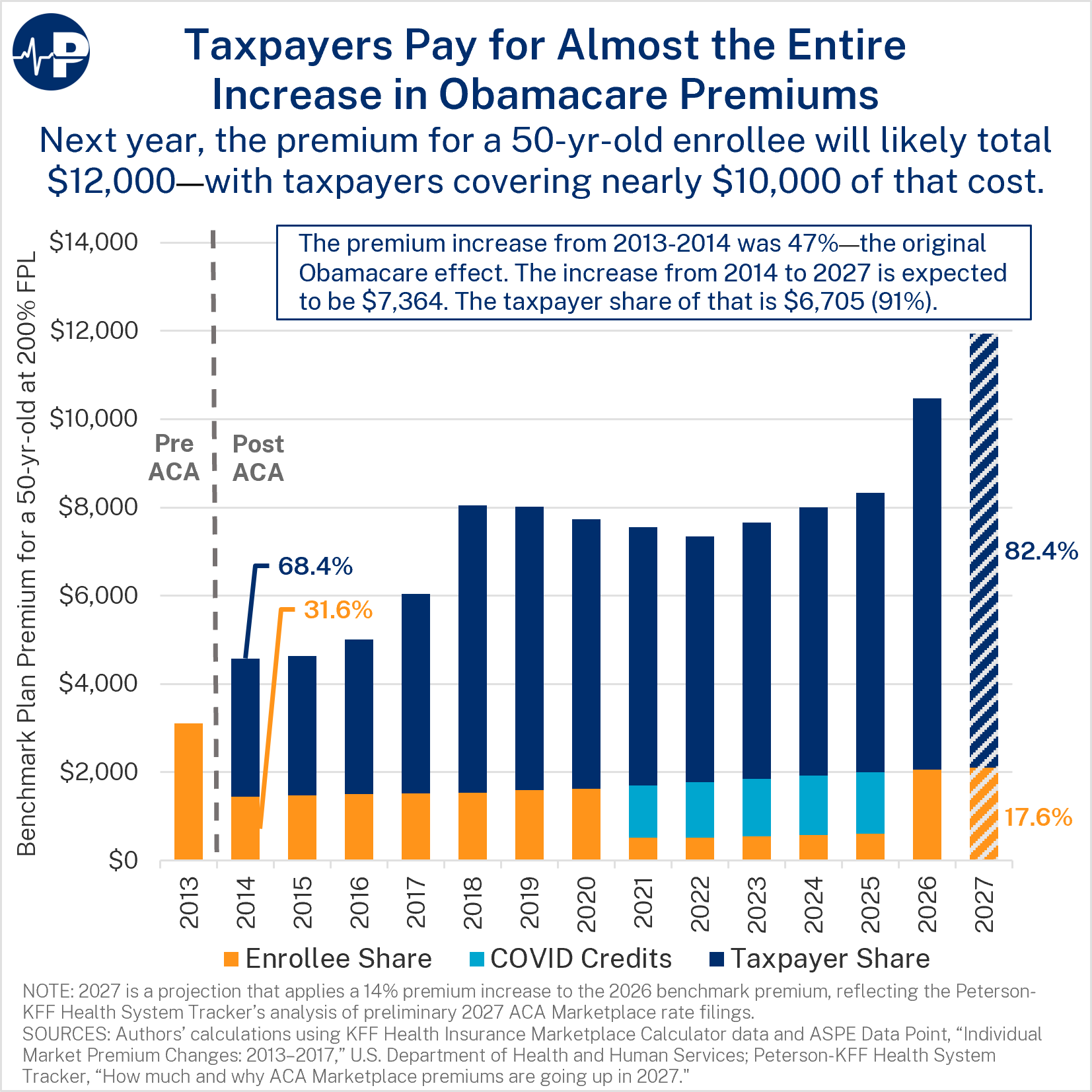
This Paragon PIC illustrates how the cost of a benchmark ACA premium has been divided between taxpayers and a representative enrollee—a 50-year-old with income at 200 percent of the federal poverty level—since the exchanges began. The orange portion represents the enrollee share, and the navy amount represents the share borne by taxpayers.

The ACA’s major coverage provisions took effect in 2014 and significantly increased individual market premiums. In that first year, taxpayers covered 68 percent of the premium. Between 2014 and 2020, the annual premium increased from about $4,500 to $8,000. Yet, the enrollee amount stayed nearly flat during this period as taxpayers absorbed almost the entire premium increase. By 2020, taxpayers covered 80 percent of the premium—a significant increase from 2014.

From 2021 to 2025, COVID-era subsidy boosts (shown in light blue) replaced much of the enrollee share with expanded subsidies. That increased the government’s share of the premium to 93 percent of the cost. Despite the COVID subsidy boosts expiring after 2025, the underlying ACA subsidy still covers more than 80 percent of the premium for this representative enrollee.

Some reports show preliminary premium increases of 14 percent in 2027, prompting claims that enrollees will face significant cost increases. As this PIC shows, that narrative is misleading. For the representative enrollee shown here, the annual out-of-pocket premium will increase by only about $40 from 2026 to 2027—roughly $3 per month. The taxpayer’s share will increase by $1,426. For this enrollee, the government will pay more than 82 percent of the premium in 2027.

Moreover, this representative enrollee pays a larger share of the premium than most subsidized marketplace enrollees. Approximately 73 percent of 2026 ACA open enrollment period sign-ups claimed income below 200 percent of the federal poverty level.  Because premium contributions decline as income falls, most subsidized enrollees pay even less toward their premiums—and taxpayers pay even more—than this figure illustrates.

19MH PIC Almost Entire Obamacare Premium Inc A0wUU000005hNkrYAE

Obamacare, including its perverse subsidy design, continues to drive up insurance premiums and health care costs by largely insulating subsidized enrollees from premium increases. The premium increases for Affordable Care Act (ACA) plans are concealed from enrollees since the enrollee’s share is capped at a percentage of their income. This subsidy design means that when insurers raise premiums, the cost is borne by the taxpayer.

This Paragon PIC illustrates how the cost of a benchmark ACA premium has been divided between taxpayers and a representative enrollee—a 50-year-old with income at 200 percent of the federal poverty level—since the exchanges began. The orange portion represents the enrollee share, and the navy amount represents the share borne by taxpayers.

The ACA’s major coverage provisions took effect in 2014 and significantly increased individual market premiums. In that first year, taxpayers covered 68 percent of the premium. Between 2014 and 2020, the annual premium increased from about $4,500 to $8,000. Yet, the enrollee amount stayed nearly flat during this period as taxpayers absorbed almost the entire premium increase. By 2020, taxpayers covered 80 percent of the premium—a significant increase from 2014.

From 2021 to 2025, COVID-era subsidy boosts (shown in light blue) replaced much of the enrollee share with expanded subsidies. That increased the government’s share of the premium to 93 percent of the cost. Despite the COVID subsidy boosts expiring after 2025, the underlying ACA subsidy still covers more than 80 percent of the premium for this representative enrollee.

Some reports show preliminary premium increases of 14 percent in 2027, prompting claims that enrollees will face significant cost increases. As this PIC shows, that narrative is misleading. For the representative enrollee shown here, the annual out-of-pocket premium will increase by only about $40 from 2026 to 2027—roughly $3 per month. The taxpayer’s share will increase by $1,426. For this enrollee, the government will pay more than 82 percent of the premium in 2027.

Moreover, this representative enrollee pays a larger share of the premium than most subsidized marketplace enrollees. Approximately 73 percent of 2026 ACA open enrollment period sign-ups claimed income below 200 percent of the federal poverty level.  Because premium contributions decline as income falls, most subsidized enrollees pay even less toward their premiums—and taxpayers pay even more—than this figure illustrates.
Related Research

No results found.
Brian Blase
President at Paragon Health Institute

Brian Blase, Ph.D., is the President of Paragon Health Institute. Brian was Special Assistant to the President for Economic Policy at the White House’s National Economic Council (NEC) from 2017-2019, where he coordinated the development and execution of numerous health policies and advised the President, NEC director, and senior officials. After leaving the White House, Brian founded Blase Policy Strategies and served as its CEO.

Mark Howell Headshot SMALLER V2

Mark Howell is a Research Assistant at Paragon Health Institute. He is passionate about advancing free-market solutions to improve healthcare access and affordability.