

Brian Blase, Ph.D., is the President of Paragon Health Institute. Brian was Special Assistant to the President for Economic Policy at the White House’s National Economic Council (NEC) from 2017-2019, where he coordinated the development and execution of numerous health policies and advised the President, NEC director, and senior officials. After leaving the White House, Brian founded Blase Policy Strategies and served as its CEO.
War on Fraud Comes to New York, Addressing Medicare’s Skin Substitute Abuse, Important FDA Reform, and More

This week’s newsletter highlights several important developments in the fight to restore integrity to federal health programs. First, the Centers for Medicare and Medicaid Services (CMS) has begun scrutinizing the most expensive and corrupt Medicaid program in the country—New York’s. I also discuss an amicus brief that I joined supporting CMS’s rule to shut down an egregious payment scheme for skin substitutes, as well as two recent Paragon Prognoses—one on FDA modernization of the drug approval process and another on how rural hospital closures are much higher in states with Medicaid provider taxes. I close with a Paragon PIC showing how phantom enrollment in the ACA exchanges can drive MLR rebates.
Medicaid Waste, Fraud, and Abuse in the Empire State
The Trump administration has begun scrutinizing New York’s Medicaid program—an overdue step given the state’s long history of excessive spending, weak oversight, and fraud. CMS Administrator Dr. Mehmet Oz recently sent a letter to Governor Kathy Hochul raising concerns about program integrity in several high-risk service areas, including personal care services, home health, adult day care, non-emergency medical transportation, and behavioral health services. These services are particularly vulnerable because they are delivered outside traditional clinical settings, where verification is difficult and billing for services that were never delivered is a persistent risk. A recent policy brief I coauthored with Chris Medrano identified four areas of Medicaid particularly vulnerable to fraud and abuse, and recommended stronger CMS enforcement.
Medicaid is a joint federal-state program in which the federal government reimburses states for a large share of their spending. Because federal funding is open-ended—states receive additional federal dollars whenever spending increases—the program is highly vulnerable to waste, fraud, and abuse. CMS therefore has a critical responsibility to safeguard the program both for the vulnerable individuals who rely on Medicaid and for the taxpayers who finance it.
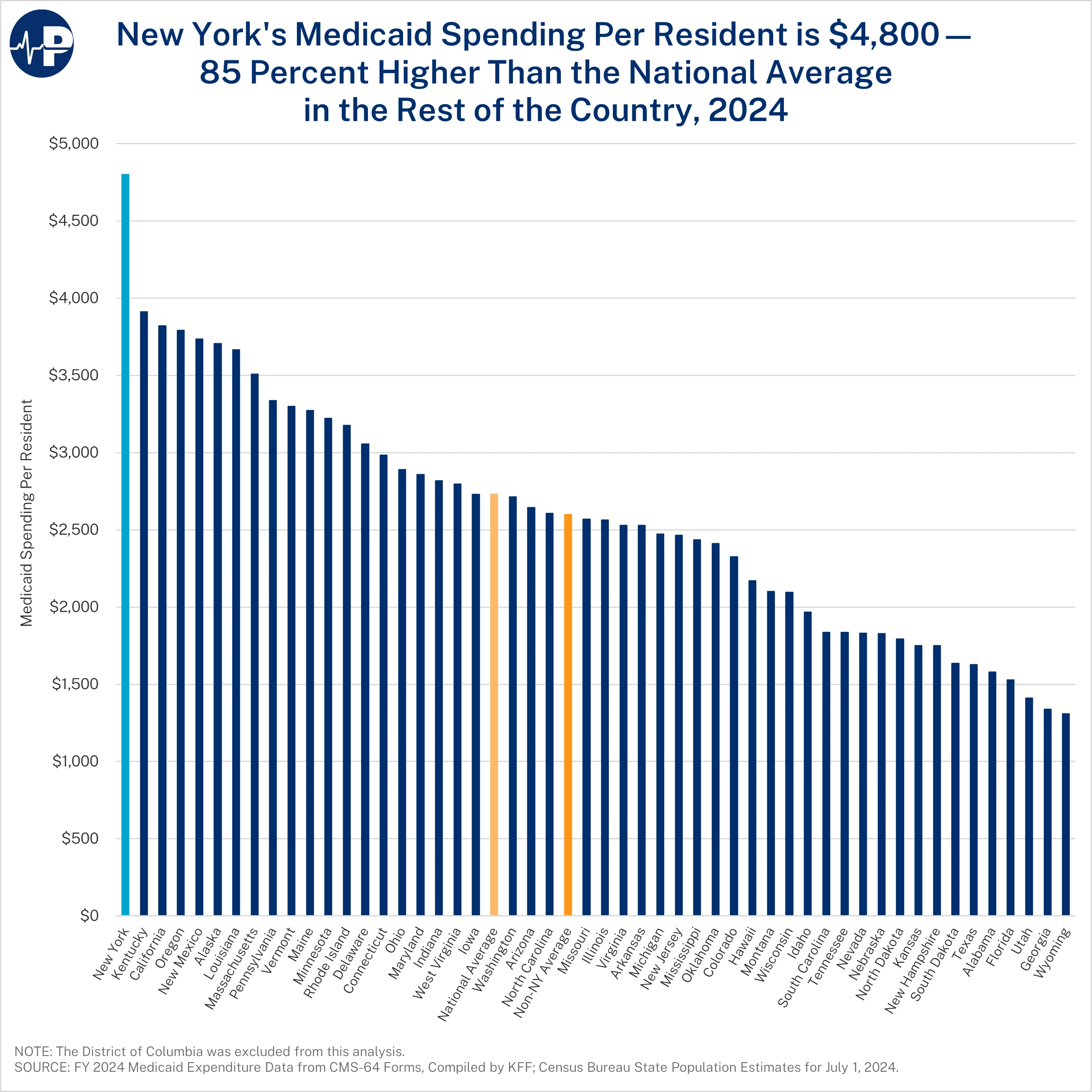
New York’s Medicaid program is disproportionately large, even for the state’s size. As the figure below shows, New York’s Medicaid spending per resident is nearly $4,800—a staggering 85 percent higher than the national average of roughly $2,600 excluding New York. New York’s per-resident Medicaid spending is 23 percent higher than that of the next highest state, Kentucky.
Medicaid waste, fraud, and abuse are rampant in New York—and have been for almost the entire 60-year history of the program. In March 2013, the House Oversight and Government Reform Committee released a bipartisan report following a year-long investigation into New York’s Medicaid program. The report documented extensive problems, including weak eligibility controls, poor oversight of long-term care services, excessive administrative costs, and political corruption. The investigation also highlighted how Medicaid had become deeply embedded in the state’s fiscal and political structure—so much so that officials referred to the practice of “Medicaiding it,” referring to the state tactic of shifting as many services and costs as possible into the Medicaid program to maximize federal funding.
Supporting CMS’s Actions to Reduce Excessive Skin Substitutes Payments
I recently joined an amicus brief supporting CMS’s rule addressing excessive Medicare payments for skin substitutes. Skin substitutes are wound-care products used to treat chronic wounds such as diabetic foot ulcers and pressure ulcers by covering the wound and promoting healing. (Please note: Once it is publicly available, we will link to the amicus brief in an updated version of this newsletter on our website.)
Under Medicare’s previous payment structure, many of these products were reimbursed in ways that created enormous financial incentives for overutilization. Manufacturers could introduce new products with very high list prices, and clinicians could purchase skin substitute products at a discounted price and then bill Medicare based on the much higher list price, allowing them to retain a large payment spread between acquisition cost and reimbursement. As the brief explains, these payment distortions created conditions ripe for excessive billing and fraud, particularly when vulnerable patients were targeted for repeated wound-care treatments.
Medicare spending on skin substitutes increased from roughly $250 million in 2019 to more than $10 billion by 2024—growth far out of proportion to any underlying change in patient needs. The problem was not simply a few bad actors; it was a payment structure that rewarded overuse.
CMS’s new policy addresses the root cause by replacing the old pricing mechanism with a flat payment structure that breaks the link between product price and physician reimbursement. By eliminating the financial spread that drove excessive billing, the rule removes a key incentive for abuse. CMS’s reform is a good example of how fixing distorted payment rules can reduce fraud far more effectively than relying solely on enforcement after the fact. The Congressional Budget Office estimates that CMS’s rule will reduce federal spending by a staggering $245 billion over the next decade—an indication of the excessive growth in skin substitute billing.
Modernizing FDA Evidence Requirements
For more than six decades, FDA approval of new drugs has typically relied on the expectation that companies conduct two clinical trials to demonstrate effectiveness—even when a single high-quality trial supported by strong confirmatory evidence may already provide clear evidence of benefit. That convention emerged in a radically different scientific environment—one with fewer analytical tools and far less ability to corroborate evidence using biomarkers or real-world data.
As Ryan Long explains in a new Prognosis, advances in medical science now allow researchers to generate strong evidence from a single high-quality clinical trial supported by additional confirmatory evidence. Replicating an expensive second trial adds substantial cost and may provide little additional scientific value when the underlying evidence is already robust.
In areas such as oncology, the FDA has already relied on a single pivotal trial supported by confirmatory evidence. A more flexible approach for other diseases and conditions can reduce development costs, shorten time to market, and expand patient access to new treatments while preserving FDA authority to require additional evidence when needed. Aligning regulatory expectations with modern scientific capabilities can therefore accelerate innovation without compromising patient safety.
Provider Taxes Do Not Save Rural Hospitals
Liam Sigaud’s latest Prognosis examines a common claim made by hospital lobbyists—that provider taxes are necessary to preserve rural hospitals. The data tell a different story.
Looking at rural hospital closures between 2005 and 2024, Liam finds that states with hospital provider taxes experienced significantly more rural hospital closures than states without them. When adjusted for population, rural hospital closures were more than three times higher in states with provider taxes.

The analysis finds no statistically meaningful relationship between provider taxes and preventing rural hospital closures. Instead, provider taxes function primarily as financing mechanisms that allow states and hospital systems to draw down additional federal Medicaid dollars.
This finding reinforces the conclusions of Paragon’s broader work on Medicaid financing. Provider taxes are best understood as financing schemes that inflate federal spending to deliver corporate welfare to large, politically connected hospital systems rather than policies that stabilize rural health care systems.
The Double Cost of Phantom Enrollees
Paragon’s new PIC highlights how phantom enrollment in the ACA exchanges can force taxpayers to pay twice for coverage that may not actually exist. The analysis focuses on zero-claim enrollees—individuals enrolled in coverage who generate no medical claims during the year.
Although some zero-claim enrollees are healthy individuals, growing evidence suggests many are phantom enrollees—people improperly enrolled without their knowledge, or fictitious identities used to obtain federal subsidies. When these phantom enrollees enter the exchanges, taxpayers first pay insurers directly through federal premium subsidies for coverage that may never be used.
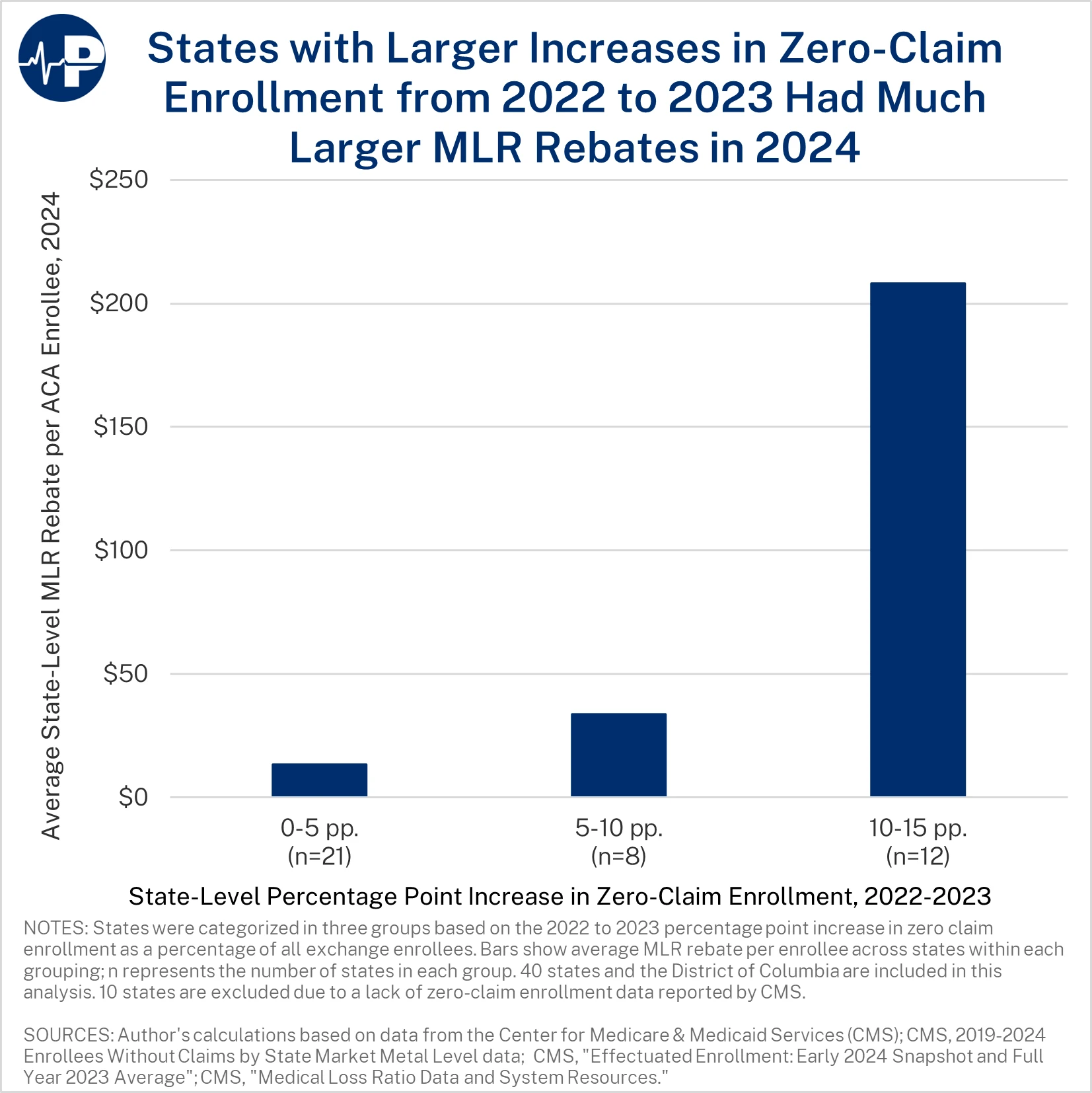
Taxpayers can then pay a second time. When large numbers of phantom enrollees generate no claims, insurers’ medical spending falls below the ACA’s medical loss ratio (MLR) requirements, triggering rebate payments. Those rebates go to enrollees—not back to taxpayers—meaning phantom enrollment produces a second round of taxpayer-financed payments.
The PIC shows that states with the largest increases in zero-claim enrollees also experienced the largest increases in MLR rebates, suggesting that improper enrollment is distorting exchange spending and forcing taxpayers to finance phantom coverage twice.
Recent Newsletters

Subscribe
Sign up now for your health policy updates.