

Brian Blase, Ph.D., is the President of Paragon Health Institute. Brian was Special Assistant to the President for Economic Policy at the White House’s National Economic Council (NEC) from 2017-2019, where he coordinated the development and execution of numerous health policies and advised the President, NEC director, and senior officials. After leaving the White House, Brian founded Blase Policy Strategies and served as its CEO.
PBM Transparency, Ending a Medicaid Money Laundering Tactic, and ACA Enrollment
Today’s newsletter discusses a proposed Department of Labor rule on pharmaceutical benefit manager transparency and a Centers for Medicare and Medicaid Services (CMS) final rule that closed an egregious state Medicaid money-laundering tactic. It also includes a Paragon Pic that provides context on the recent ACA enrollment numbers.
Before I get to the important rules, I wanted to preview two significant policy briefs that we plan to release next week. On Monday, we will release a Medicare brief that reviews key Trump administration administrative changes in 2025 and recommends a set of policies to build on those reforms. On Wednesday, we will release a brief detailing four areas of Medicaid that are particularly vulnerable to waste and fraud, and reviewing CMS actions to address waste and fraud in Minnesota.
Last week’s discussion between Paragon’s Demetrios Kouzoukas, who ran the Center for Medicare in President Trump’s first term, and the current Center for Medicare head, Chris Klomp, was the most widely attended virtual event in Paragon history, and the video is available here. The discussion occurred the day after the Medicare Advantage rate notice. At the event, Klomp expressed strong support for Medicare Advantage and the value that it delivers to seniors while also stating that risk adjustment should not be a source of competitive advantage untethered from clinical reality.
Lastly, Congress has now passed the Consolidated Appropriations Act of 2026—here are the key health care provisions included in the final package.
DOL PBM Transparency Rule
On January 29, the Department of Labor proposed a new rule that would require pharmacy benefit managers (PBMs) to fully disclose their compensation and fees to self-insured group health plans. The rule aims to give plan fiduciaries clearer information to evaluate whether PBM charges are reasonable and potentially secure better terms. Self-insured plans provide coverage for roughly 90 million Americans. This proposal represents a meaningful effort to bring greater transparency to the prescription drug supply chain.
Under the proposed rule, PBMs would be required to disclose rebates and other payments received from drug manufacturers; compensation earned through spread pricing, where the plan’s payment to the PBM for a given drug exceeds the amount the PBM reimburses the pharmacy; and payments recouped from pharmacies in connection with drugs dispensed to plan participants. The proposed rule would also allow plan fiduciaries to request audits of PBMs to verify the accuracy of the reported information, further strengthening oversight and accountability.
CMS Shuts Down Egregious Medicaid Provider Tax Scheme
On January 29, CMS announced its final rule, Preserving Medicaid Funding for Vulnerable Populations – Closing a Health Care-Related Tax Loophole. The rule reforms how CMS evaluates state taxes on providers to determine whether those taxes qualify for a waiver from the requirement that provider taxes be broad-based and uniform. As we explained in our comment letter on the proposed rule, CMS’s previous test allowed states to impose egregiously uneven taxes designed to extract more federal Medicaid dollars. In practice, states structured these taxes to fall almost exclusively on Medicaid insurers—entities that directly benefit from the higher Medicaid payment rates generated by the federal funds the taxes were designed to pull in. The result was a financing scheme that formally complied with the rules while clearly violating their intent.
Provider taxes are state-designed financing mechanisms used to maximize federal Medicaid funding while minimizing state spending. These arrangements function as Medicaid’s central money-laundering mechanism, shifting costs onto federal taxpayers. The abuse is most acute with MCO taxes, which CMS has long treated differently from other provider taxes in ways that are especially vulnerable to manipulation. Last year, we highlighted how California enacted an abusive MCO tax to draw down roughly $17 billion in federal Medicaid funds without any new state spending—and then used that windfall to expand Medicaid to unauthorized immigrants. At least six other states have adopted similarly egregious schemes.
CMS first moved to shut down this loophole in a proposed rule issued in May. In July, President Trump signed the One Big Beautiful Bill, which included a provision specifically aimed at ending this MCO tax scheme. CMS’s final rule builds on its earlier proposal and implements that statutory directive. The agency estimates that closing this loophole will save federal taxpayers more than $78 billion over the next decade—resources that can instead be used to preserve Medicaid’s core mission of supporting truly vulnerable populations.
What Do We Know About ACA Enrollment?
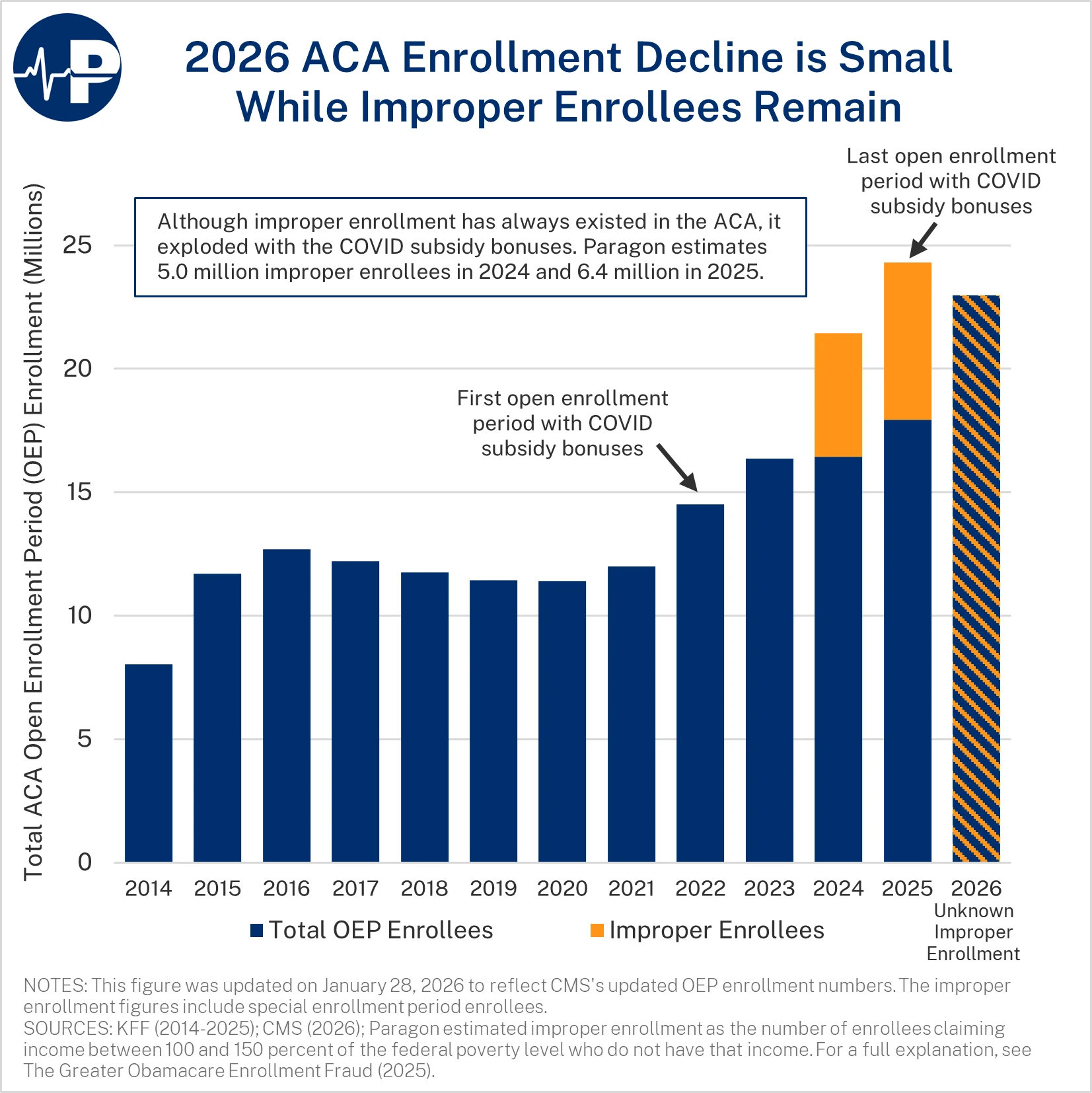
On January 28, CMS released data on 2026 open enrollment for the Affordable Care Act (ACA) exchanges, reporting 23.0 million sign-ups—a slight decline from 24.2 million sign-ups in 2025. There were 19.6 million returning enrollees and 3.4 million new enrollees. New enrollment is down 14 percent from last year. Eighty-five percent of 2026 enrollees are returning customers. CMS has not released the breakdown in existing enrollees who were automatically renewed into their coverage versus those who changed plans.
Initial sign-ups are higher than many expected, although there will likely be more attrition during the year. This is because some phantom enrollees—which I estimated at between 3 and 4 million in 2025—will be disenrolled during the year as more of them will have a premium payment. With the expiration of the COVID-era subsidy bonuses, there are no fully subsidized silver plans. However, because of silver-loading, fully subsidized bronze plans are universally available and, in some states, fully subsidized gold plans are also available. There will be some continuation of phantoms in fully subsidized bronze or gold plans, but they should be removed from silver plans if they fail to pay premiums.
Importantly, improper enrollment—defined as enrollees claiming income between 100 and 150 percent of FPL to obtain larger subsidies despite not having that income—constituted an estimated 6.4 million enrollees in 2025. Paragon will update our analysis later this year, but we expect improper enrollment to remain high, given extensive auto-re-enrollment, the absence of a minimum required premium payment, and the lack of penalties for many enrollees who misstate their income.
The figure below shows that enrollment remains well above any year other than 2025. The reality is that underlying ACA subsidies are extremely large and grow on autopilot because they cap enrollee premiums at a fixed amount regardless of the total premium. With the distortionary impact of silver-loading, the subsidies are even larger than originally intended by the ACA authors. As a previous Paragon Pic has demonstrated, roughly 85 percent of the premiums consisted of taxpayer subsidies with the COVID-era subsidy bonuses in place—and that percent will almost certainly only fall into the 75-80 percent range with those subsidies expired.
Recent Newsletters


Subscribe
Sign up now for your health policy updates.