

Brian Blase, Ph.D., is the President of Paragon Health Institute. Brian was Special Assistant to the President for Economic Policy at the White House’s National Economic Council (NEC) from 2017-2019, where he coordinated the development and execution of numerous health policies and advised the President, NEC director, and senior officials. After leaving the White House, Brian founded Blase Policy Strategies and served as its CEO.
Senate Finance Committee Adds to House Progress on Reducing Medicaid Money Laundering

States have long deployed money laundering schemes to inflate federal Medicaid payments without a commensurate increase in state spending. Those money laundering schemes, the subject of a comprehensive Paragon report in March, exploded during the Biden administration.
States use gimmicks, such as provider taxes, to generate revenue that they use to fund the state share of Medicaid spending. By leveraging these funds, states inflate payments to providers, drawing down additional federal dollars. While some of these federal funds flow back to providers, states often retain a portion for unrelated budget items. Providers, particularly hospitals, clamor for, and frequently help develop these schemes because states guarantee them higher payment rates. Paragon breaks down how these schemes work in a recent video: “Provider Tax Money Laundering Scheme Explained.”
The money laundering schemes have contributed to a massive shifting of costs from states to the federal government over the past 15 years and produce significant corporate welfare, allowing hospitals and insurers to make excessive profits from Medicaid. On average, states only bear 25% of Medicaid expenditures—down from the historic percentage of 40%.
The House Addressed Medicaid Money Laundering Apparatus in Three Ways
The One Big Beautiful Bill (OBB) that passed the House of Representatives contained three key provisions aimed at reducing Medicaid money laundering.
First, OBBB froze the “hold harmless” threshold for allowable Medicaid provider tax rates. Provider taxes are schemes in which states “tax” providers, use the money raised to obtain federal funds, and then increase payments to those very same providers using those federal funds. Under current law, the “hold harmless” threshold allows states to essentially guarantee that providers will receive back the taxes paid if the tax is not more than six percent of a provider’s revenue. Alaska is the only state without a Medicaid provider tax.
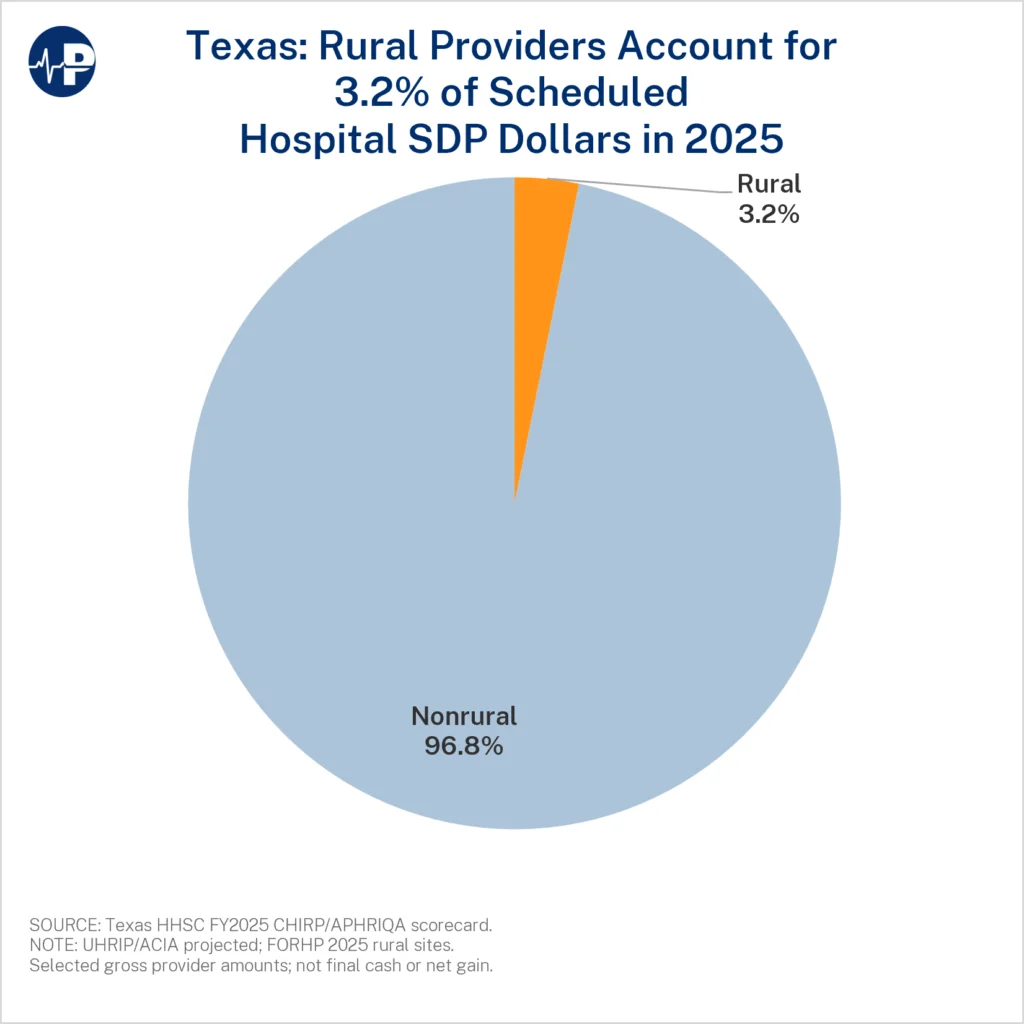
Second, OBBB capped state-directed payments (SDPs) at 100% of Medicare rates in Medicaid expansion states and 110% in non-expansion states. Critical access hospitals should not be affected by this policy change since they are reimbursed based on costs and are outside of Medicare’s rate schedule..
SDPs are additional payments that states make to providers, mostly hospitals in states that contract with an insurance company to run their Medicaid programs. Federal funding for SDPs is obtained using the money laundering apparatus. Currently, Medicaid fee-for-service is subject to an upper payment limit (UPL) that caps federal reimbursement at Medicare rates. However, no such limit exists in Medicaid managed care, and Medicaid payments through SDPs can significantly exceed Medicare rates.
A 2024 Biden administration regulation permitted SDPs up to average commercial rates (ACR). ACRs are more than 2.5 times Medicare, meaning that many providers in many states find treating Medicaid patients much more lucrative than treating Medicare patients. More than 80% of American voters support reforms that limit Medicaid payments to no more than Medicare rates.
Third, OBBB codifies the closing of a loophole to the uniformity and redistribution test for provider taxes. Some states, including California, have deployed taxes that are many times higher on Medicaid entities than private ones. In California, the tax was more than 100 times higher on Medicaid plans so that the state could then funnel money back to the plans with higher Medicaid payments, leveraging federal funds. California was able to obtain $10 billion in federal funds without any actual state contribution, money it used to expand Medicaid coverage for unauthorized immigrants. OBBB would shut down this egregious provider tax design by codifying an important proposed Trump administration rule.
Senate Improvements
The Senate would take significant additional steps to reduce Medicaid money laundering: reducing states’ ability to use provider taxes in Medicaid expansion states and bringing existing SDPs into compliance with the Medicare cap.
Phasing Down Provider Taxes in Medicaid Expansion States
First, it would build on the freeze of the “hold harmless” threshold for provider taxes by reducing states’ ability to launder federal funds through provider taxes in states that expanded Medicaid. Beginning in 2027, the hold harmless threshold—i.e., the federal limit on permitted money laundering—in expansion states for provider classes other than nursing or intermediate care facilities would be reduced by 0.5 percent annually until the maximum hold harmless threshold reaches 3.5 percent in 2031.
In his fiscal year 2012 and 2013 budgets, then-President Obama proposed a 3.5 percent limit for provider taxes. The Washington Post wrote a strong editorial endorsing the phase down as “a much needed Medicaid reform.” Then Vice-President Biden went further, calling provider taxes “a scam” that should be eliminated.
The reason to phase down provider taxes just in Medicaid expansion states is because expansion states receive a higher return on their provider tax schemes. On average, $1 of money laundered funds brings in 7 times more funding when applied to the Obamacare expansion of able-bodied, working-age adults because of the much higher federal reimbursement rate. For this reason, the exclusion of nursing homes and ICF facilities makes sense since their residents are almost entirely enrolled in the traditional program, where the state receives a much lower federal reimbursement percentage.
Bringing Existing SDPs into Compliance with the Medicare Cap
The House-passed OBBB did not specify requirements or a process for bringing existing SDPs into compliance with the Medicare cap. The Senate would direct the Secretary of Health and Human Services to reduce the SDP limits by 10 percent annually until the allowable Medicare-related payment limit is achieved. Lowering SDPs is sensible policy because the current higher allowances represent expensive corporate welfare and put upward pressure on commercial rates by linking higher Medicaid payments to commercial rates. In essence, this reform brings Medicaid payments through insurers in parity with the UPL applied to Medicaid fee-for-service programs.
Many states will be unaffected by these sensible changes. As mentioned previously, SDPs apply to those states that contract with health insurers to administer their Medicaid programs. States with predominantly fee-for-service Medicaid programs, such as Maine or Alaska, will not be affected by this change.
One Recommendation: A Faster Phase-in
Congress should consider a steeper reduction or state that all SDPs need to be compliant within a set number of years, perhaps five, after enactment of the legislation. In some states, the ACR is 3 times Medicare rates, if not higher. Thus, it could take two decades or longer for some SDPs to come into compliance with Medicare rates. This is too long a glidepath, which would allow states to take advantage of the federal system for longer, while diverting resources to politically-connected providers.
Related Content

Subscribe
Sign up now for your health policy updates.