



The House has introduced the Lower Health Care Premiums for All Americans Act to address some of the problems from the Affordable Care Act (ACA) that are driving skyrocketing health care costs, and to provide American families and small businesses with more options for more affordable coverage. The bill is expected to receive a vote later this week. Its reforms to government health policy would reduce premiums for the most common ACA plan and for employer coverage. This legislation stands in stark contrast to proposals that seek to extend the inflationary ACA subsidies—proposals that would mask rising premiums and exacerbate waste, fraud, and abuse in the exchanges.
The Lower Health Care Premiums for All Americans Act appropriates cost-sharing reduction (CSR) subsidies to lower premiums and federal spending, expands employer access to association health plans (AHPs), codifies individual coverage health reimbursement arrangements (ICHRAs) and improves them as CHOICE arrangements, enacts pharmacy benefit manager (PBM) transparency, and preserves employers’ ability to offer self-funded insurance plans.
Lowering Premiums 12 Percent: CSR Subsidies
The ACA’s CSR program reduces cost-sharing amounts, including deductible and out-of-pocket payment amounts, for silver plan enrollees who claim income below 250 percent of the federal poverty level (FPL). Yet the ACA did not contain a valid appropriation for CSR funds, which led the courts to determine that the Obama administration was making unlawful payments to insurers. The Trump administration complied with the courts, and insurers responded by “silver loading,” which resulted in much higher silver plan premiums and correspondingly higher premium subsidies because the subsidy is tied to a silver plan premium.
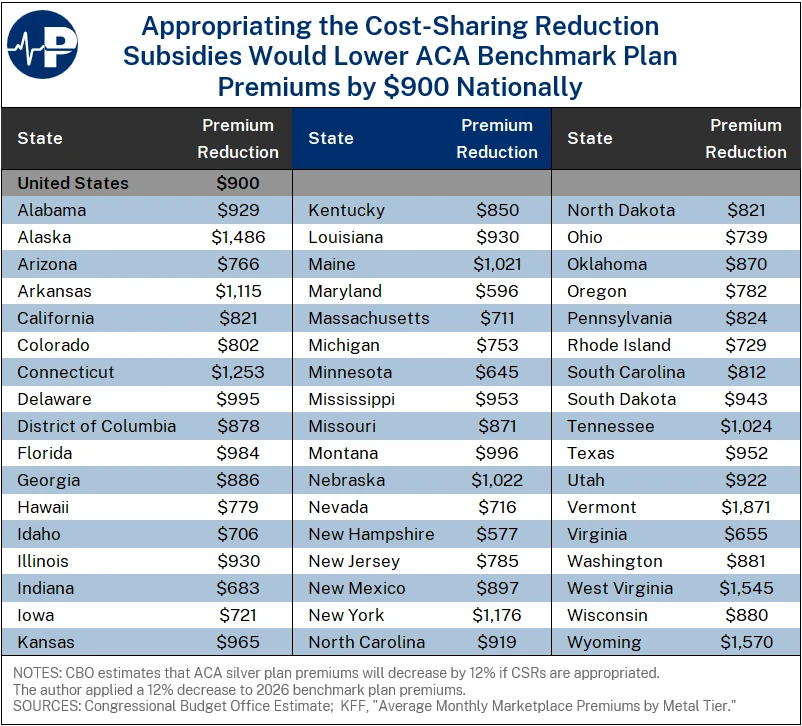
Appropriating CSRs more efficiently targets taxpayer assistance, restoring the original ACA structure by directly funding insurers and unwinding destructive silver loading. The Congressional Budget Office (CBO) estimates that a CSR appropriation would cause silver plan premiums to drop by 12 percent, resulting in average annual premium savings of roughly $900 for a 40-year-old single adult, with state results shown in the table below. Lower benchmark premiums would also reduce federal premium subsidies, saving taxpayers more than $30 billion on net over ten years.
Helping Small Businesses Offer Coverage: Association Health Plans
An association health plan (AHP) is a legal pooling instrument that permits businesses to cooperatively sponsor a single large group health plan covering the businesses’ workers. This single group plan benefits from the greater purchasing power afforded by its cross-company employee aggregation. An AHP covers pre-existing conditions, protects employees and individuals with a medical condition, and provides the same type of comprehensive and affordable health coverage offered by large employers. The House bill improves access to AHPs for businesses (including small businesses run by the self-employed).
The large group health plans made accessible through AHPs are regulated under the Employee Retirement Income Security Act (ERISA) and often provide a wider range of benefits and better networks than ACA exchange plans. For those large group plans that choose to self-insure, they obtain additional advantages derived from a regulatory flexibility that smaller groups do not enjoy within traditional commercial coverage.
Unfortunately, current regulations leave most small businesses without a viable AHP option in their area and the small group insurance market available to them has severely deteriorated as a result of the ACA. With coverage options both limited and high-priced, it is difficult for small employers to offer health benefits. Small businesses are roughly one-third as likely to offer health coverage as firms with 100 or more employees. This situation, in turn, pushes their workers toward the ACA exchanges and shifts insurance costs to taxpayers for those employees who qualify for premium subsidies.
In 2018, the Department of Labor updated regulations to broaden AHP access beyond industry-based associations of employers to include employer associations within a common state or metropolitan area. This 2018 rule launched successfully with employers across the U.S. offering more affordable coverage to their workers through AHPs. Savings from these new AHPs were as high as 23 percent to 29 percent (depending on commercially insured versus self-funded plans). As The Washington Post noted at the time, a review of over two dozen of these health plans indicated they were “offering generous benefits and premiums lower than can be found in the Obamacare marketplaces.” The rule allowed groups like the Southern Arizona Chamber of Commerce to offer affordable coverage to small businesses in seven southern Arizona counties. Despite this promising start, 11 states successfully sued to block the rule, and these coverage options were forced out of the market.
The Lower Health Care Premiums for All Americans Act would codify key elements of President Trump’s 2018 AHP rule to provide more small employers opportunities to offer better health insurance to their employees, which can help reduce the employee health coverage divide existing between small and large employers. The legislation would improve upon the regulation by permitting additional flexibility in how the coverage could be priced to encourage the formation of AHPs.
Expanding CHOICE: Improving ICHRAs
The Lower Health Care Premiums for All Americans Act would codify the 2019 individual coverage health reimbursement arrangements (ICHRA) rule and renames them “Custom Health Option and Individual Care Expense” (CHOICE) arrangements. Under CHOICE arrangements, employers contribute tax-free funds for workers to buy ACA-compliant individual market plans. CHOICE arrangements allow employers another avenue to assist their employees with health coverage by letting them determine contribution amounts and letting employees choose the coverage they prefer. The legislation also contains a small and temporary tax credit to small employers that offer CHOICE arrangements, which will incentivize uptake and expand coverage. Overall, this provision will provide another way for employers to offer coverage, with small employers receiving a tax benefit for doing so, while expanding employee options, enhancing portability, and improving the underlying ACA individual market risk pool.
Increasing Price Transparency: PBM Reporting
Three pharmacy benefit managers (PBMs) control around 80 percent of the market. In a market this concentrated, transparency is essential for customers and employers to understand the available choices. Currently, plan sponsors must contend with obscure rebate structures, fees, and opaque reporting. The bill requires semiannual disclosures to plan sponsors about retained versus passed-through rebates, exact pass-through rates, total drug expenditures, acquisition costs versus reimbursements, and manufacturer fees. More accurate data would empower audits, shine a light on revenue-maximizing tactics, and foster competition. PBM transparency will enable plan sponsors, particularly employers, to better understand benefit design options, tailor plans to enrollee needs and put downward pressure on plan premiums.
Reducing Costs: Protecting Stop-Loss Coverage from Unnecessary Regulation
Self-insured plans, which are offered by employers that cover more than 60 percent of employees, are able to avoid some regulation that raises premium costs. One method that helps self-insured employer plans to control costs is through stop-loss insurance against large claims.
Some states have attempted to regulate stop-loss insurance even when it is purchased by self-funded plans under ERISA. ERISA plans are generally exempt from state regulation because they are employee benefit plans offered across state lines. State regulation of reinsurance can make it onerous, if not impossible, for employers to offer self-funded plans for their workers. The House proposal amends ERISA to exempt qualifying stop-loss plans from “health insurance coverage,” which means that ERISA plans would not be subject to state regulation of these arrangements. ERISA preemption will preserve this option, resulting in lower health care costs for employers and translating into somewhat higher take-home pay for employees.
Summary
Last week, Senate Republicans introduced legislation that would appropriate CSRs, expand access to ACA catastrophic plans, and introduce government contributions to health savings accounts for ACA exchange enrollees who select bronze or catastrophic plans. My colleague Brian Blase wrote a Prognosis about that legislation last week. It secured 51 votes in the Senate, but not the 60 needed for passage.
The Senate legislation, like the Lower Health Care Premiums for All Americans Act, wisely did not expand the inflationary, distortionary, and wasteful COVID-era ACA subsidy boosts. Addressing deep structural flaws of the ACA that are driving up costs and premiums, amplified by the COVID subsidy boosts, will be an ongoing effort. To meet these ends, policymakers should consider expanding access to guarantee renewable short-term health-insurance plans, opening up ACA catastrophic plans, taking steps to expand access to HSAs, and site neutral payment reform in government programs. However, the Lower Health Care Premiums for All Americans Act contains a strong initial set of policies that expand choice, particularly for small employers, enhance competition and transparency, and reduce ACA silver plan premiums by 12 percent while lowering federal spending by roughly $30 billion.