


A Myth that Won’t Die
A persistent myth that confuses the health care policy debate and energizes advocacy for higher government spending on hospitals is cost shift. It goes like this: Medicare and Medicaid do not pay hospitals enough to cover their costs, so hospitals hike rates for private payers—mainly those with employer-based health plans—to make up the difference. If only Medicare and Medicaid paid more, hospitals would charge lower rates to people with private insurance.
The cost-shift hypothesis is not simply that private insurers pay more than Medicare or Medicaid. It is the causal claim that when government pays less, hospitals respond by charging private insurers more to offset those lower public payments. While the cost-shift hypothesis has intuitive appeal, it does not withstand careful scrutiny.
The myth resurfaced in the debate over the One Big Beautiful Bill Act. Even though that law results in Medicaid spending more than $600 billion (2027-2036) over the pandemic-era forecast, that increase did not satisfy hospitals’ demands. Media reports documented threats from hospitals “to make up for lower volumes and more uncompensated care by securing higher reimbursements from other payers.” The leader of a large employer health purchasing group echoed the claim: “Cost-shifting is a well-established practice among hospital leaders. There’s a reasonable risk that if Medicaid is cut, they will be seeking to make up those losses from employers.”
As a result, the myth succeeds in conscripting even those who should favor reducing health spending to advocate for more government spending instead. Fortunately, the myth has little support in either economic logic or empirical evidence.
Origins of the Myth
Both employer-sponsored health plans and Obamacare plans pay hospitals higher rates than Medicare does. A 2024 study of all hospital inpatient and outpatient services found that employer-sponsored plans paid, on average, 254 percent of what Medicare would have paid for the same services at the same facilities.
Some analysts suggest Medicaid rates are even lower than Medicare rates. While this was true for much of Medicaid’s history, shifts in state financing tactics and federal policies have radically raised Medicaid’s payments to providers in many states. The surge in supplemental payments (i.e., lump-sum payments that are not connected to a specific patient or episode of care) has increased effective Medicaid rates in many states. A landmark 2017 analysis concluded that average Medicaid payment for 18 selected conditions was 6 percent higher than Medicare. Further, Medicaid payments have risen near average commercial rates in many states through the growth of provider taxes, a type of legalized money laundering, fueling state-directed payments.
Observing this gap between private and government payers, defenders of the theory have described a “cost-shift payment hydraulic”: As some pay less, others must pay more. The government now directly finances over 50 percent of health expenditures in the US (including Medicare, Medicaid, Department of Defense, and the Veterans Administration, but excluding other public-sector health benefits), up from about 42 percent in 2000 and just over 20 percent in the early 1960s (before Medicare and Medicaid existed). According to the theory, government controls this spending via political power rather than market participation, and therefore forces hospitals to accept artificially low prices that do not fully cover their costs.
Defenders also point out that hospitals have high fixed costs, like airlines. Just like an airline prefers to fill an empty seat as long as the marginal revenue from filling that seat covers the variable cost of flying the passenger, a hospital will gladly accept Medicare patients if Medicare revenue covers the variable costs of treating the patient.
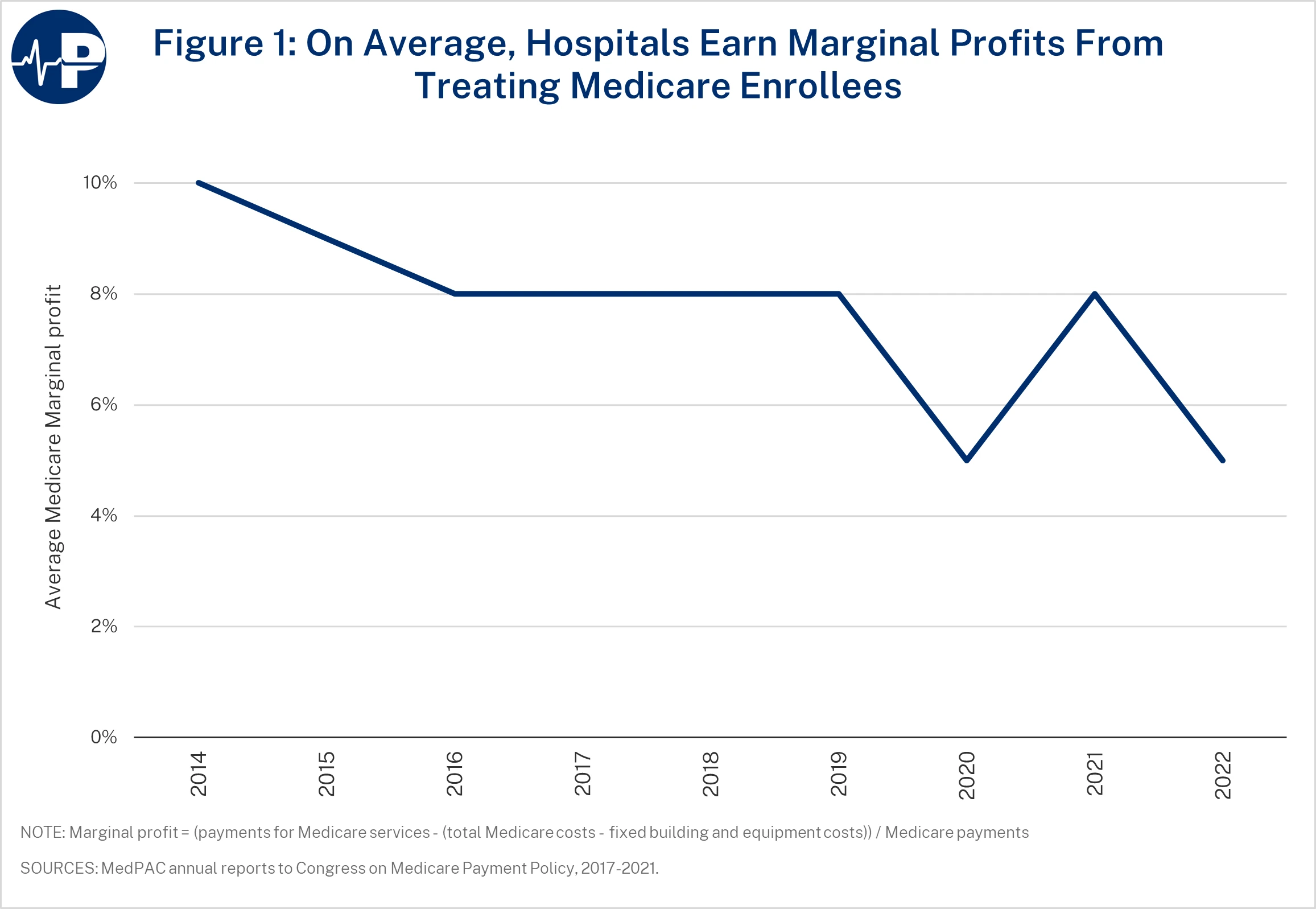
By this measurement, Medicare is profitable for hospitals, as shown in Figure 1. “Marginal profit,” a term defined by the Medicare Payment Advisory Commission, measures how much Medicare pays hospitals above hospitals’ variable costs of treating Medicare patients. Medicare marginal profit exceeded 10 percent in 2014, and was about 9 percent in 2015. From 2016 through 2019, hospitals’ Medicare marginal profit was 8 percent. In 2020, Medicare marginal profit dropped to 5 percent, returned to 8 percent in 2021, and dropped to 5 percent again in 2022 and remained positive in 2023.
However, these profits do not cover the fixed costs of operating hospitals.
According to the Medicare Payment Advisory Commission (MedPAC), hospitals’ margin when accounting for both variable and fixed costs was -12.1 percent in 2024.
At first glance, the theory of cost shifting appears plausible: If government payers will not cover total operating costs, it looks like private payers have to pick up the slack to allow hospitals to stay in business. But that conclusion is incorrect as it ignores key facts.
Dispelling the Myth
A 2025 study published by the California Health Care Foundation (CHCF) thoroughly reviewed the literature on cost shift. Some studies from the 1980s through early 2000s indicated payment-to-cost ratios were rising for private payers while falling for government payers. These findings offer circumstantial support for the cost shift theory. However, the literature exhibited some inconsistent results, and this pattern has since waned. By the end of the first decade of the 21st century, the cost-shift theory began to suffer a series of blows that proved fatal.
In debates following the Medicare cuts expected after the Affordable Care Act passed in 2010, hospital lobbyists frequently invoked the cost-shift theory to lobby for relief. A 2013 literature review dismissed these concerns as unsupported by evidence. (Hospitals need not have worried about the ACA’s supposed Medicare cuts anyway: Medicare’s hospital rates exploded after the ACA.)
Another article published in 2013 confirmed private payers’ rates tend to follow the trend in Medicare rates. From 1995 to 2009, a 10 percent reduction in Medicare payment was associated with a 7.7 percent reduction in private payment. Indeed, cuts in Medicare rates might have led hospitals to cut rates for private payers to attract more privately insured patients.
A 2011 article concluded that changes in market power between health insurers and hospitals explained changes in rates far better than the cost shift theory. The 2025 review updated the evidence that rates fluctuate based on market power shifting between payers and hospitals, not the behavior of government plans. For example, the rise of HMOs in the 1980s and 1990s increased payers’ market power and drove payment rates to hospitals down. Subsequent waves of consolidation among both hospitals and insurers have led to market power shifting back and forth in subsequent decades.
Another 2010 article indicates the cost-shift theory has cause and effect backwards, concluding that hospitals with higher shares of patients covered by private insurance have higher costs. The authors suggest these hospitals are less subject to cost discipline than hospitals more subject to government programs. Therefore, they have greater losses on their Medicare patients.
Finally, a study looked at the effect of the 2008 stock market crash. Hospitals have large endowments which account for a significant share of their profits or losses. The 2008 crash gave hospitals a great excuse to cost shift, but the average hospital could not do it. Rather, they delayed investments in health technology and cut unprofitable services.
In essence, hospitals do not leave money lying on the ground until a reduction in government rates or other crisis motivates them to pick it up. Rather, hospitals behave like other suppliers of goods or services which have high fixed costs: They attempt to maximize profits by price discriminating, i.e., by charging different customers different prices based on their willingness to pay. Not every payer has to cover all costs, as long as each payer covers the variable costs for the patients it covers.
Of course, this begs the question: If government payment doesn’t cover fixed costs, how can hospitals survive in an environment where government programs dominate?
Hospitals Versus Airlines
Defenders of the theory of cost shift have pointed to airlines as another industry that has to cope with high fixed costs. However, airlines cannot blame government payers for shifting costs to an increasingly consolidated industry of insurers. Rather, airlines compete in a market of individual passengers who have no market power, but where prices are set by markets, not government bureaucracies subject to massive lobbying pressure. Figure 2 shows the results over the past quarter century.
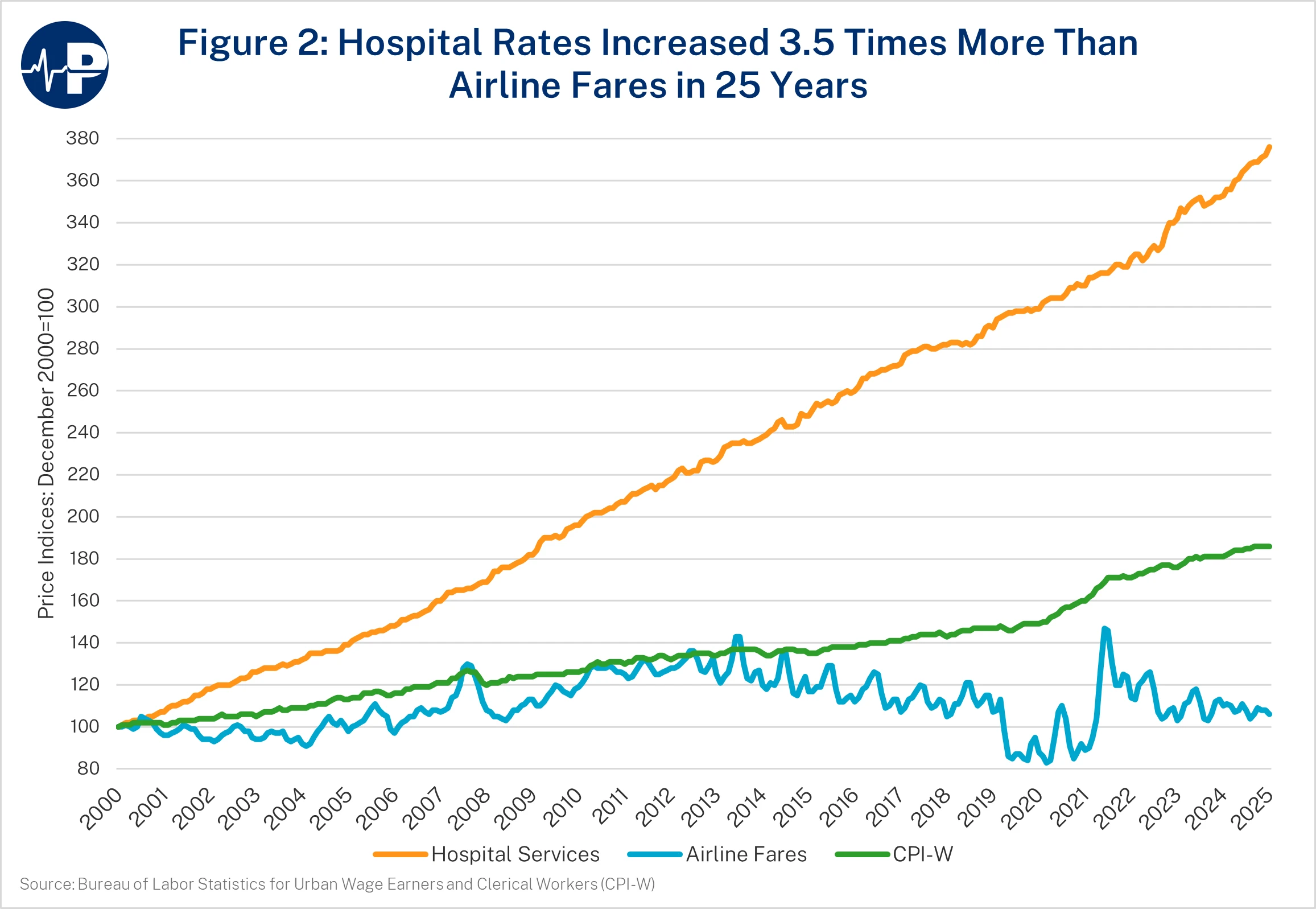
In the quarter century from December 2000 through December 2025, prices of hospital services increased 376 percent, while airline fares increased by just 6 percent. The overall Consumer Price Index increased by 86 percent. Thus while hospital prices have outpaced inflation by more than four times, inflation-adjusted airline fares have gotten much cheaper.
So, companies in industries with high fixed costs can remain profitable by developing pricing strategies that induce passengers to cover total costs. They do not complain about cost shift. Rather they develop price discrimination strategies and adjust their prices to appeal to different customer types. Yes, once in a while an airline goes bankrupt, but nobody thinks there will be a systemic wave of bankruptcies that will leave us stranded without flights. Despite two recessions since 2000, passenger load within the U.S. increased almost 40 percent from 2000 to 2019 (the last year before the COVID-19 pandemic).
Cost Shift As Government Failure
Although the usual narrative of cost shift is a myth, it is true that government can and does artificially increase costs for private payers.
First, unlike an airline, a hospital does not have to reduce fixed costs over the long term to gain more consumers. Instead, its Medicare payments automatically ratchet up along with the fixed costs which it attributes to its Medicare patients. When fixed costs increase, so does the basis for calculating Medicare’s payments. Other government policies (including limiting payment to physician-owned hospitals and Certificate of Need laws) inhibit low-cost competitors from entering the market, for which private payers also pay the price.
Second, when states set Medicaid payment rates as a function of average commercial rates (a trend that has accelerated over the past several years), it encourages providers to increase commercial rates to secure higher Medicaid payments. For example, North Carolina sets its Medicaid rates by linking to average commercial rates, which are more than twice Medicare rates. As documented by Ge Bai and Ann Kempski, this arrangement inflated commercial prices and fueled vertical consolidation in the state.
Policymakers who accept the myth of cost shift condemn Americans to more decades of spiraling health costs. Hospital affordability problems are better addressed through increased competition, site-neutral and other payment reforms, and repealing Certificate of Need laws, than by accepting a flawed cost-shift narrative.