


Paragon Health Institute Icon White
Paragon Pic

A Growing Majority of States Are Restricting Cell Phones in Schools

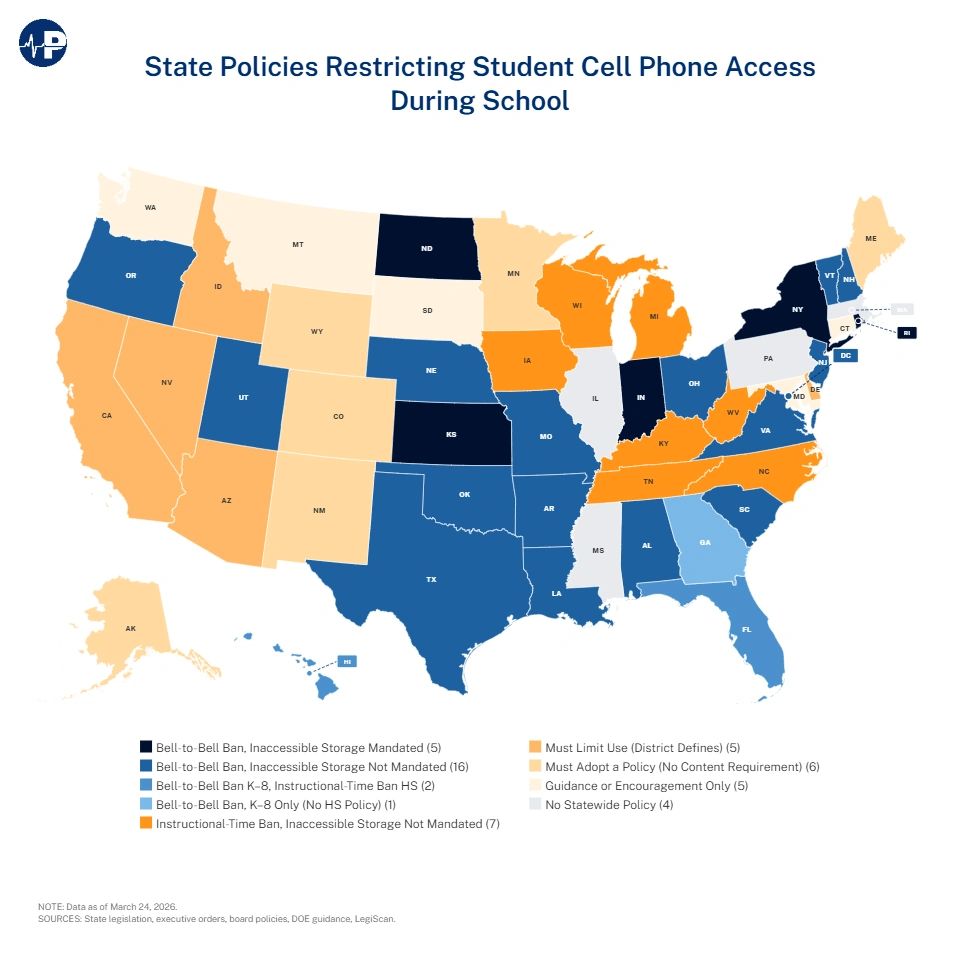
8KH PIC Phone Policy Heatmap
Click the Pic to expand the image
Katherine Hall Headshot SQUARE 20251205

Katherine Hall is a Research Assistant at Paragon Health Institute. Before joining Paragon, Katherine worked on supply-side health policy as an intern at the Niskanen Center. She also completed a fellowship with the Health Reformers Academy, where she studied market-based approaches to healthcare reform.

Kansas recently became the latest state to enact a cell phone ban for the entire school day. It joins a growing majority of states restricting student phone use in schools to combat the negative effects of screen time on academic performance, classroom focus, and well-being. As more states pursue these policies, they appear to be learning from one another: newer legislation increasingly favors stricter, bell-to-bell bans.

As of March 24, 2026, 35 states and Washington, D.C., have adopted some form of phone restriction for at least K–8th graders, with most state actions occurring in 2025 and early 2026.

Twenty states and D.C. require bell-to-bell bans for all grades (prohibiting phones from arrival to dismissal), and three more apply bell-to-bell bans only to grades K–8. Seven states have statewide instructional-time bans for all grades (prohibiting phones during class only), and five more states require districts to adopt a policy limiting phone use. Most state policies set a minimum standard and require districts to develop and implement their own policies that meet or exceed it.

Fifteen states have not yet enacted meaningful statewide restrictions on cell phone use. Six states require districts to adopt some policy regulating phone use without specifying limits, five have statewide guidance recommending but not requiring restrictions on phone use, and four have no statewide policy requirement at all. In states without statewide bans, districts may choose to adopt their own policies, though it is not required.

The strongest state policies are those that implement full bell-to-bell bans with inaccessible storage requirements. A Paragon Bill Spotlight showcased legislation enacted in June 2025, which requires every public school to adopt a policy prohibiting students from having physical access to cell phones throughout the entire school day—including non-instructional periods like lunch and passing time. Other similarly strong state approaches include North Dakota, Indiana, and most recently Kansas.

A recent Paragon policy brief reviewing the literature on cell phone bans in schools found that bell-to-bell bans show the best results, and are associated with meaningful academic gains, particularly for low-achieving students, and reductions in behavioral problems and bullying. One New York City school reported a 50 percent increase in after-school activity attendance following a ban, suggesting that phone-free school days restore in-person social habits. Partial restrictions such as instructional-time bans provide more limited benefits—when phones remain accessible during lunch or between classes, their pull on student minds persists during the school day.

A recent Paragon PIC reinforces why storage requirements matter. When phones are stored away and inaccessible, just 28 percent of educators report classroom disruption, compared to nearly half when students can keep phones on their person, even when prohibited from using them. This share rises to nearly three-quarters when phones are permitted between classes. Disruption peaks when teachers set their own rules rather than following a uniform school policy, with nearly eight in ten educators reporting at least some disruption. The data make clear that instructional-time bans alone are insufficient to improve classroom performance and student attention; full-day phone ban policies with inaccessible storage requirements—consistently enforced across every classroom—are most effective.

Several states without statewide bans are actively considering new legislation, including Pennsylvania and Maryland, which have bell-to-bell ban proposals moving through their legislatures. States with partial bans are also looking to expand: Georgia is advancing legislation that would extend its bell-to-bell ban to high school, and Wisconsin is considering legislation to upgrade its instructional-time ban to a full bell-to-bell ban.

As states continue to act, Paragon recommends following the lead of states like Rhode Island and North Dakota and implementing policies that prohibit student access to cell phones for the entire school day.

8KH PIC Phone Policy Heatmap

Kansas recently became the latest state to enact a cell phone ban for the entire school day. It joins a growing majority of states restricting student phone use in schools to combat the negative effects of screen time on academic performance, classroom focus, and well-being. As more states pursue these policies, they appear to be learning from one another: newer legislation increasingly favors stricter, bell-to-bell bans.

As of March 24, 2026, 35 states and Washington, D.C., have adopted some form of phone restriction for at least K–8th graders, with most state actions occurring in 2025 and early 2026.

Twenty states and D.C. require bell-to-bell bans for all grades (prohibiting phones from arrival to dismissal), and three more apply bell-to-bell bans only to grades K–8. Seven states have statewide instructional-time bans for all grades (prohibiting phones during class only), and five more states require districts to adopt a policy limiting phone use. Most state policies set a minimum standard and require districts to develop and implement their own policies that meet or exceed it.

Fifteen states have not yet enacted meaningful statewide restrictions on cell phone use. Six states require districts to adopt some policy regulating phone use without specifying limits, five have statewide guidance recommending but not requiring restrictions on phone use, and four have no statewide policy requirement at all. In states without statewide bans, districts may choose to adopt their own policies, though it is not required.

The strongest state policies are those that implement full bell-to-bell bans with inaccessible storage requirements. A Paragon Bill Spotlight showcased legislation enacted in June 2025, which requires every public school to adopt a policy prohibiting students from having physical access to cell phones throughout the entire school day—including non-instructional periods like lunch and passing time. Other similarly strong state approaches include North Dakota, Indiana, and most recently Kansas.

A recent Paragon policy brief reviewing the literature on cell phone bans in schools found that bell-to-bell bans show the best results, and are associated with meaningful academic gains, particularly for low-achieving students, and reductions in behavioral problems and bullying. One New York City school reported a 50 percent increase in after-school activity attendance following a ban, suggesting that phone-free school days restore in-person social habits. Partial restrictions such as instructional-time bans provide more limited benefits—when phones remain accessible during lunch or between classes, their pull on student minds persists during the school day.

A recent Paragon PIC reinforces why storage requirements matter. When phones are stored away and inaccessible, just 28 percent of educators report classroom disruption, compared to nearly half when students can keep phones on their person, even when prohibited from using them. This share rises to nearly three-quarters when phones are permitted between classes. Disruption peaks when teachers set their own rules rather than following a uniform school policy, with nearly eight in ten educators reporting at least some disruption. The data make clear that instructional-time bans alone are insufficient to improve classroom performance and student attention; full-day phone ban policies with inaccessible storage requirements—consistently enforced across every classroom—are most effective.

Several states without statewide bans are actively considering new legislation, including Pennsylvania and Maryland, which have bell-to-bell ban proposals moving through their legislatures. States with partial bans are also looking to expand: Georgia is advancing legislation that would extend its bell-to-bell ban to high school, and Wisconsin is considering legislation to upgrade its instructional-time ban to a full bell-to-bell ban.

As states continue to act, Paragon recommends following the lead of states like Rhode Island and North Dakota and implementing policies that prohibit student access to cell phones for the entire school day.
Related Research

No results found.
Katherine Hall Headshot SQUARE 20251205

Katherine Hall is a Research Assistant at Paragon Health Institute. Before joining Paragon, Katherine worked on supply-side health policy as an intern at the Niskanen Center. She also completed a fellowship with the Health Reformers Academy, where she studied market-based approaches to healthcare reform.