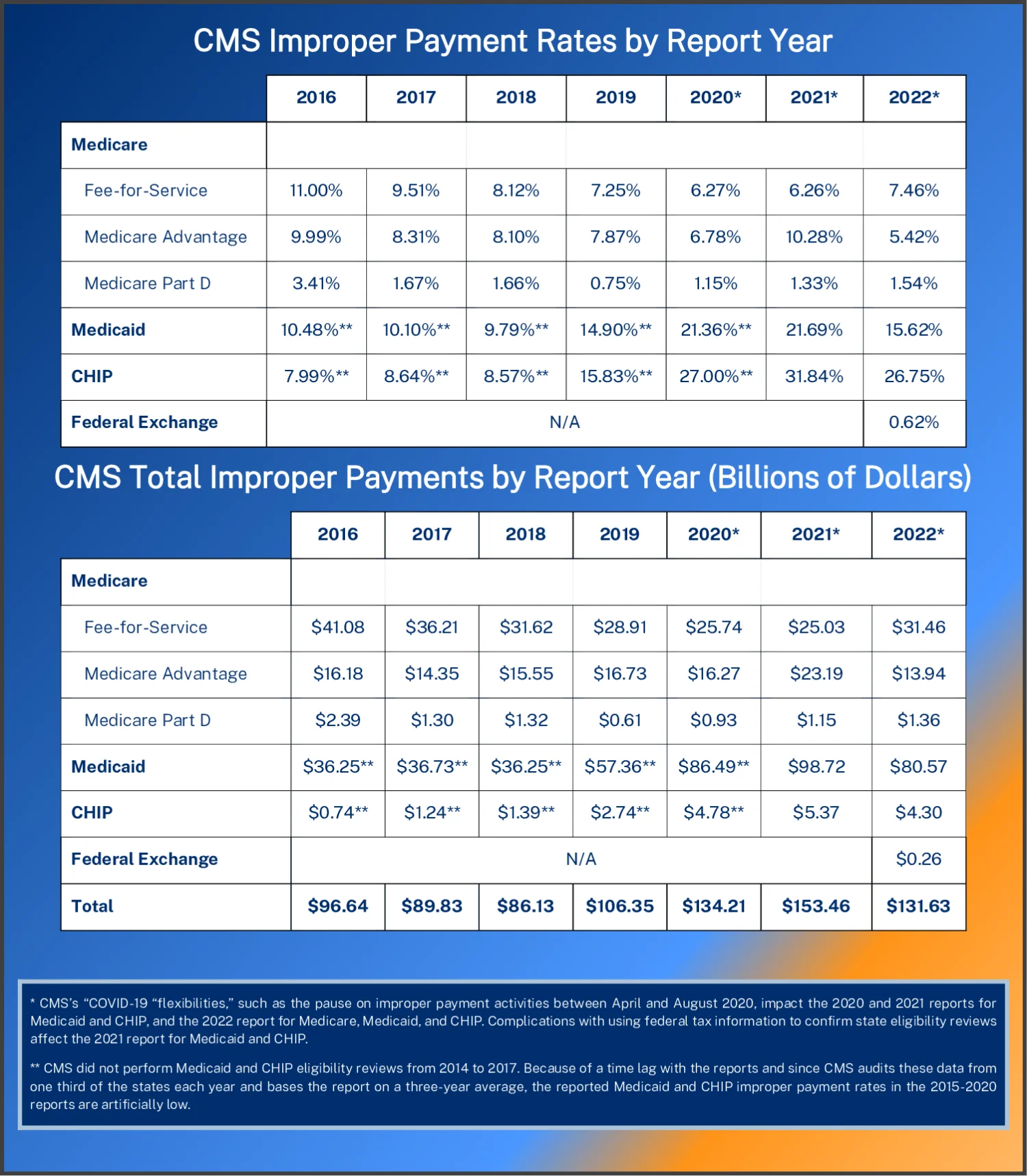
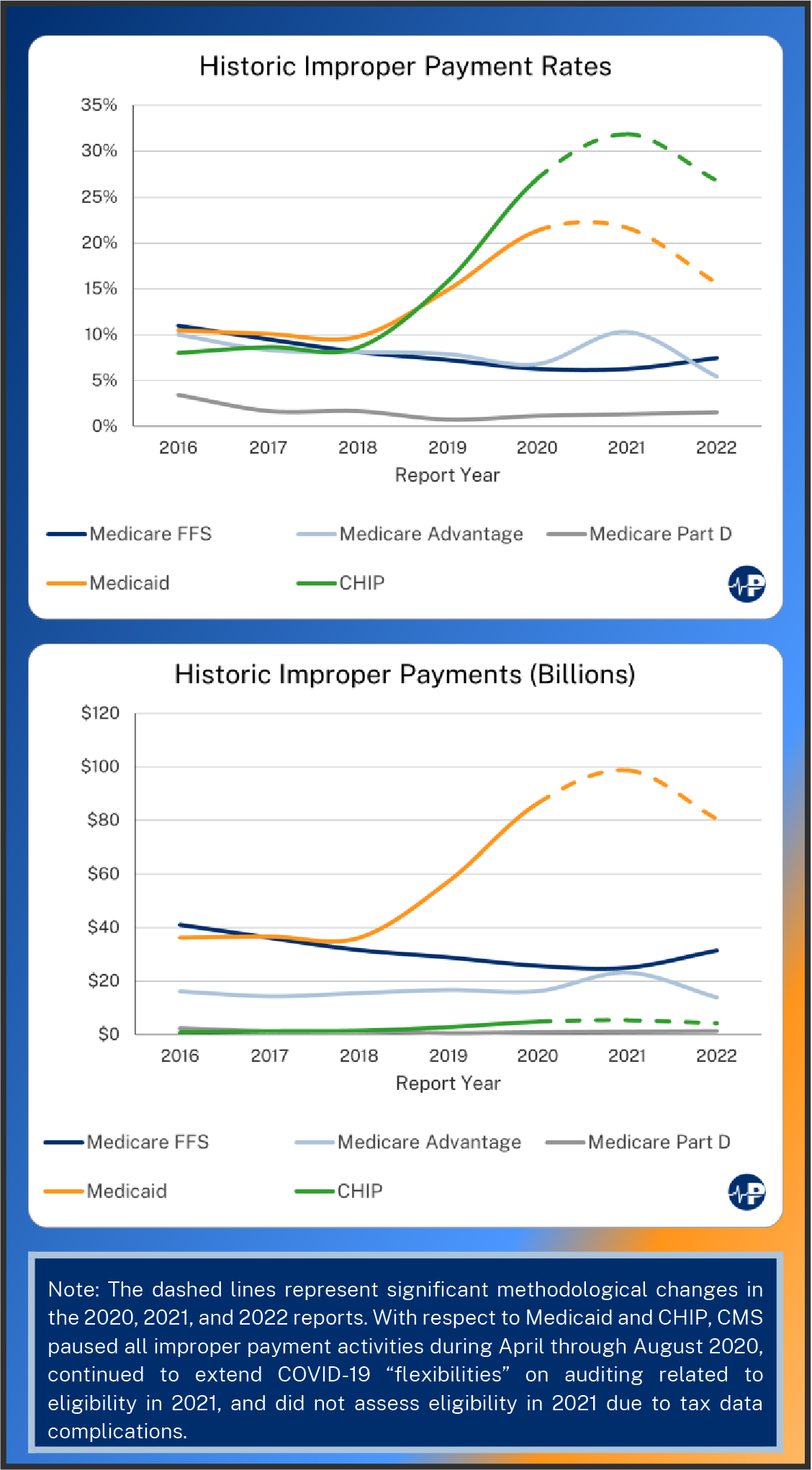
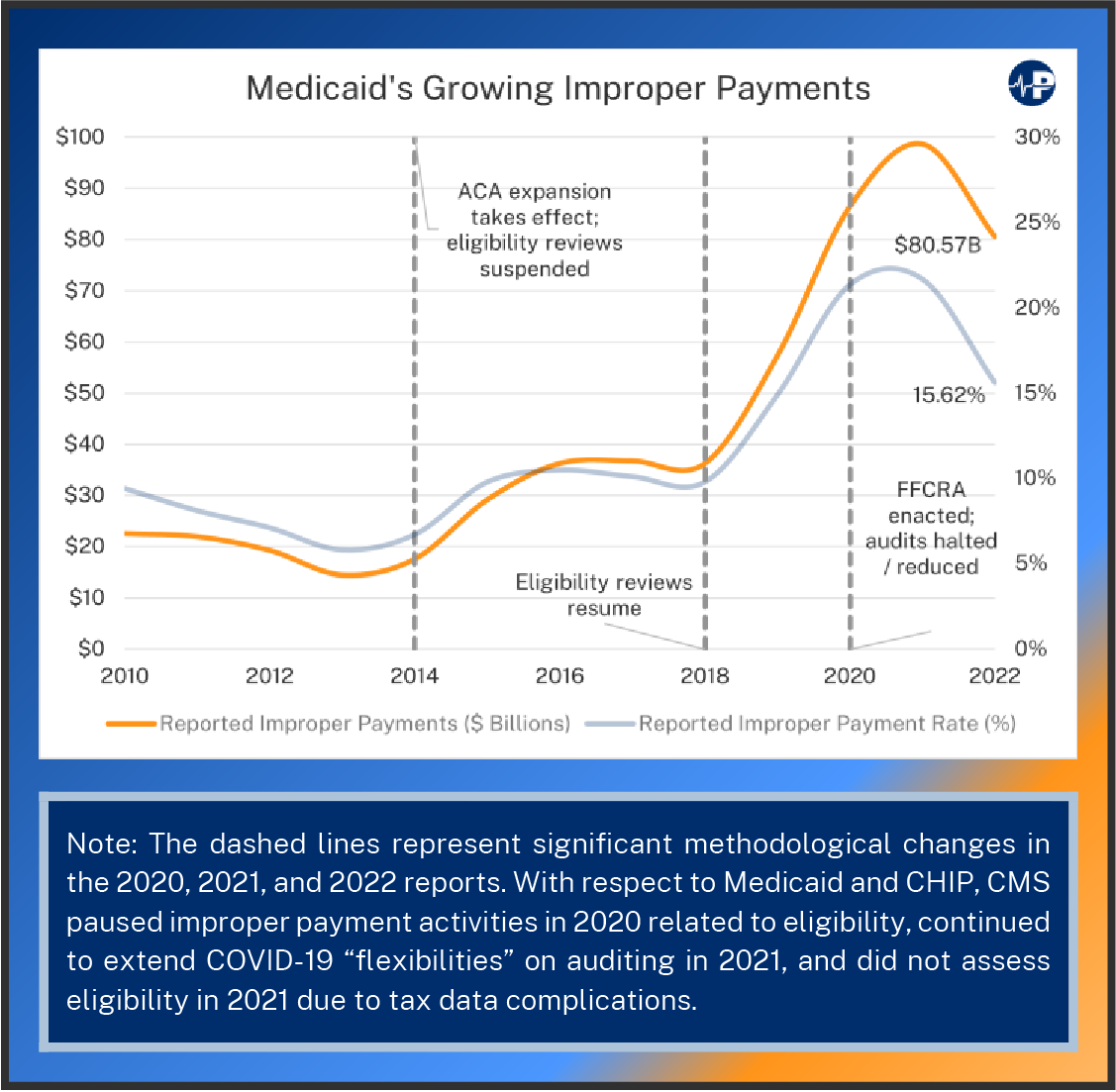
Medicaid’s reported improper payment rate declined in the 2022 report to 15.6 percent, which is an artificially low figure due to CMS’s decision to reduce eligibility audits. Medicaid now provides coverage to about one in four Americans. Such rapid expansion and high rate of improper payments are indicators that taxpayers are suffering from poor government policy and program management.
A poorly run Medicaid program also harms the truly needy by misallocating resources. The recent, drastic growth in improper payments has coincided with the Affordable Care Act’s (ACA’s) Medicaid expansion. Medicaid was originally designed to assist the most vulnerable Americans, such as low-income pregnant women, children, seniors, and individuals with disabilities. However, the ACA expanded Medicaid to able-bodied adults by enticing states with generous financial incentives. Much of the improper payment problem in Medicaid results from the enhanced federal reimbursement rate for the ACA expansion population. The enhanced reimbursement rate creates a significant incentive for states to enroll people under the expansion criteria even if those people would have been eligible to be enrolled under the prior criteria and thus at the lower reimbursement rate.
Indeed, the ACA’s Medicaid expansion not only diverts more resources from those most in need but also has produced much higher improper payments. In the two reporting years before the ACA’s Medicaid expansion took effect, Medicaid’s improper rate averaged about six percent. With the expansion, the improper payment rate increased substantially, reaching more than 20 percent in the 2020 and 2021 reports. The main reason for the growth in Medicaid’s improper payments is that states have failed to ensure people on the program are actually eligible. After conducting audits over a six-month period in 2014 and 2015, HHS’s Office of the Inspector General estimated that just two states—California and New York—made at least $1.7 billion in Medicaid improper payments to cover at least 1.6 million enrollees who were ineligible for the program (estimating at least $4.3 billion more in spending on 3.9 million “potentially” ineligible enrollees, or those enrolled without a proper review of their information and may not have been eligible).
Since the ACA expansion, CMS has failed to adequately track this rise in misspending on ineligible enrollees. CMS stopped eligibility reviews as part of its overall audits from 2014 to 2017, so the reported Medicaid payments for those years (found in the 2015 through 2020 reports) do not reflect true improper payment estimates. When it restarted eligibility reviews in 2018, there was a huge increase in reported improper payments (from a $36 billion in the 2018 report to $57 billion in the 2019 report), even though only one-third of states had eligibility reviews accounted for in the 2019 report. The 2020 report showed a further surge in Medicaid improper payments (up to $86 billion) as a second third of the states were reviewed for eligibility. Those states, like the first third reviewed, consistently failed to properly determine eligibility for the program. The 2021 report did not fully assess eligibility in the final third of states, citing complications with using federal tax information for income verification. Despite this, Medicaid improper payments still rose to $99 billion in that report.
Other shortcomings in CMS’s error measurement stem from the COVID-19 pandemic. CMS paused all its improper payment activities from April to August 2020. The most recent report again cited “COVID-19 flexibilities,” such as postponed eligibility determinations, as a factor in its lower reported improper payments rate in the third of states reviewed this year. In short, even this report, which excuses significant problems and does not include meaningful eligibility audits, indicates a high improper payment rate.
The ACA expansion created high improper payments in Medicaid, but the policy response to COVID-19 has only exacerbated it. The enactment of the Families First Coronavirus Response Act (FFCRA) in March 2020 increased federal financial support of Medicaid so long as states did not update their eligibility requirements or remove ineligible people from the program until the public health emergency ends. CBO estimated in June 2022 that over one in six Medicaid enrollees—nearly 13 million people—are ineligible for the program but remain enrolled due to these policies. The Urban Institute’s estimate of ineligible Medicaid enrollees is 16 million people as of the end of September 2022. Because CMS suspended or reduced its activities for collecting improper payment data due to the COVID-19 pandemic, recent reports have undercounted Medicaid and CHIP errors.