

Brian Blase, Ph.D., is the President of Paragon Health Institute. Brian was Special Assistant to the President for Economic Policy at the White House’s National Economic Council (NEC) from 2017-2019, where he coordinated the development and execution of numerous health policies and advised the President, NEC director, and senior officials. After leaving the White House, Brian founded Blase Policy Strategies and served as its CEO.
CMS’s SDP Rule, Agreeing with Larry Levitt on Hospital Prices, New PICS on Troubling Payment Trends, and Calling for Essays on Medicaid Managed Care

This week’s newsletter starts with Paragon’s comments supporting CMS’s proposed rule implementing key Medicaid reforms in the One Big Beautiful Bill (OBBB). I then highlight an important commentary from KFF Executive Vice President Larry Levitt on why hospital prices deserve far more attention in the national affordability debate, followed by two new Paragon PICs on distortionary government health care policies: 1) the Affordable Care Act (ACA) subsidy design and 2) increasing Medicaid payment differentials that advantage services delivered in hospitals versus independent physician offices. The newsletter concludes with our call for essays on Medicaid managed care.
CMS’s Proposed State-Directed Payment Rule Is a Major Step Toward Medicaid Reform
CMS’s proposed rule implementing sensible limits on state-directed payments (SDPs) represents one of the most significant Medicaid program integrity reforms in decades. Over the past several years, SDPs have exploded in size, becoming the primary vehicle through which states use provider taxes and other financing gimmicks to shift Medicaid costs to federal taxpayers while delivering large corporate welfare payments to politically powerful hospital systems.
The proposed rule implements—and appropriately expands upon—the OBBB’s limits on Medicaid managed care payments while also establishing new limits on fee-for-service supplemental payments. Our comment letter strongly supports the proposal and explains why these reforms will protect Medicare enrollees by preventing Medicaid from paying substantially more than Medicare for the same services, improve provider incentives, and reduce wasteful spending. These reforms also align with public opinion: more than four in five American voters support limiting Medicaid payment rates to no more than Medicare rates. CMS projects that the rule will reduce federal spending by $500 billion—dramatically improving social welfare by reducing the excess burden of taxation.
We also recommend several improvements, including accelerating implementation where legally permissible; interpreting statutory deadlines consistent with congressional intent; strengthening transparency; closely monitoring state efforts to circumvent the reforms; and improving the regulatory impact analysis by recognizing the social benefits that result from reducing federal deficits and the excess burden of taxation.
Why Is There More Talk of High Drug Prices Than High Hospital Prices?
Paragon helped focus national attention on the role hospitals play in rising health care prices with our April research paper, The Hospital Cost Crisis: How Government Policies Drive Consolidation, Undermine Competition, and Fuel Soaring Prices. The paper, authored by John R. Graham, documented that hospital prices have risen three times faster than inflation since 2000—outpacing all other sectors of the U.S. economy. Soon after publication, the House Ways and Means Committee held a hearing at which members questioned health system CEOs about skyrocketing costs and outrageous billing practices.
Last week, Levitt posed a question on X that deserves far more attention: “Why is there a whole lot more talk about drug prices than hospital prices? Paraphrasing bank robber Willie Sutton: If we want to restrain health spending, we have to go where the money is—hospitals.”
He then pointed readers to his JAMA Forum article, in which he explains why drug prices receive more attention than hospital prices, even though hospital care accounts for roughly one-third of U.S. health care spending—about 3.5 times as much as retail prescription drugs. Levitt offers the following compelling explanations:
- Retail drug prices are “clearly identifiable”—patients see sticker prices at pharmacies, compare them internationally, and encounter frequent reminders through ads and monthly fills. In contrast, hospital prices are opaque and complex, involving bundled services, ancillary tests, separate professional fees, and unpredictable bills that defy easy shopping or comparison, even with transparency rules.
- People spend more out of pocket for drugs than hospital care because of insurance design, so patients feel drug costs more directly.
- More people need medications than hospital care. Two-thirds of adults take medications. Only one in ten adults is admitted to the hospital each year.
- Finally, the “face” of the issue matters—drug companies appear profit-driven, represented by executives in suits and backed by heavy advertising, while hospitals are represented by trusted clinicians in white coats and scrubs.
In The Hospital Cost Crisis, Paragon shows why hospitals are drivers of health care unaffordability: The fundamental problem is that government policies subsidize consolidation, weaken competition, narrow consumer choice, and undermine efficiency. If policymakers are serious about making health care more affordable, hospital prices need to be at the center—not the periphery—of the debate. The path to more affordable health care is not greater government intervention, but reversing the government policies that have made hospitals larger, less competitive, and more expensive.
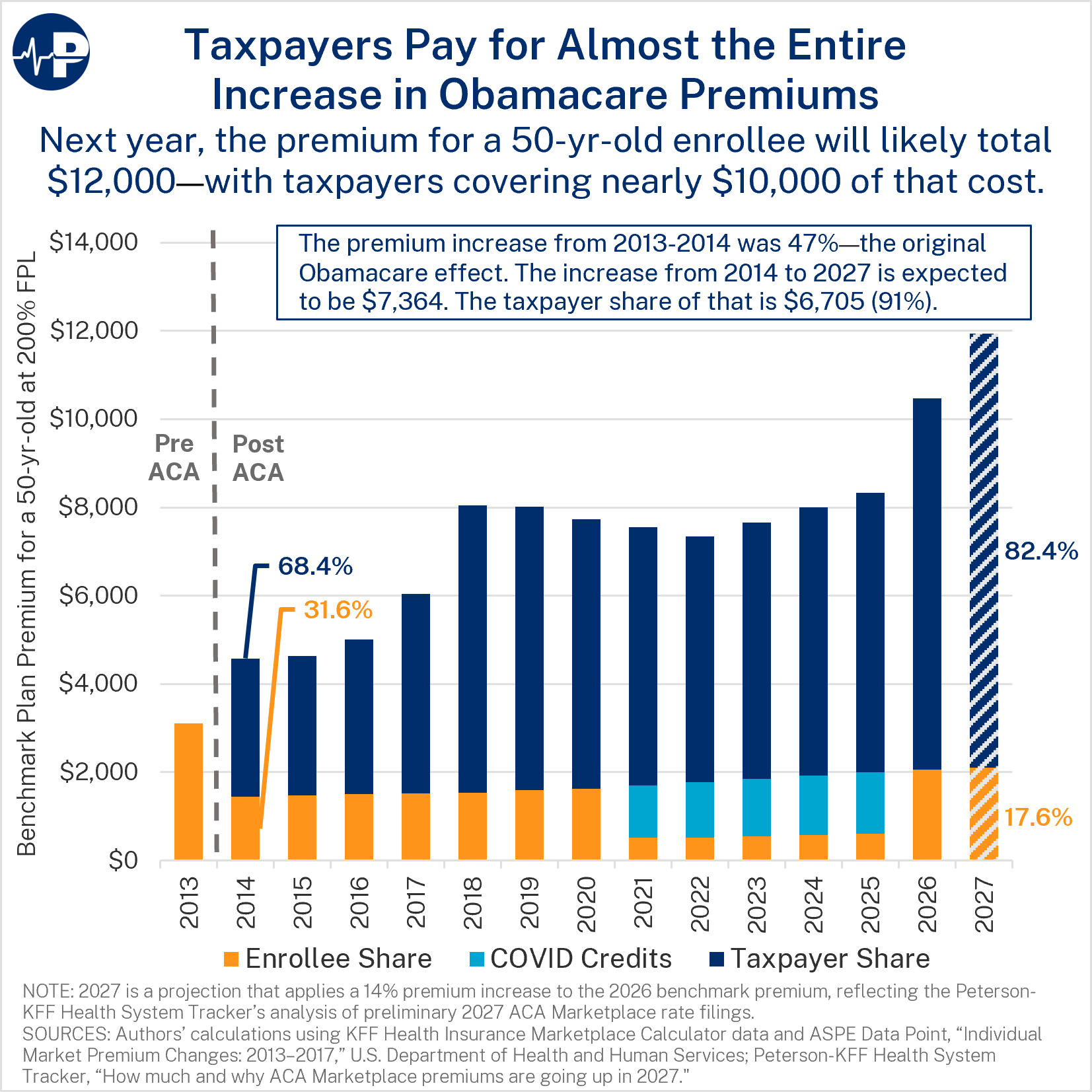
Paragon PIC: Taxpayers Pay for Nearly All Obamacare Premium Increases
Nearly 90 percent of ACA exchange enrollees receive subsidies, and they are almost totally insulated from premium increases. Because subsidies rise along with benchmark premiums, taxpayers bear almost the entire cost of higher premiums.
This updated Paragon PIC illustrates just how dramatically this dynamic has evolved. Since the ACA’s major coverage provisions took effect in 2014, benchmark premiums have risen substantially, yet the typical subsidized enrollee’s required contribution has remained relatively flat. Nearly all of the increase has instead been shifted to taxpayers.
Paragon PIC: Medicare’s Site-of-Service Payment Gap Continues to Grow
Medicare often pays substantially more for the same outpatient service when it is performed in a hospital outpatient department than in an independent physician’s office. Our new Paragon PIC shows that this payment disparity is large, growing, and expected to widen further.

This growing disparity results from Medicare’s use of two separate payment systems. Services delivered in hospital outpatient departments generally generate both a facility payment under the Outpatient Prospective Payment System (OPPS) and a professional payment under the Physician Fee Schedule (PFS), while services delivered in independent physician offices generally generate only a PFS payment. The result is a payment structure that subsidizes hospital-based care, encourages hospitals to acquire independent physician practices, weakens competition, and increases costs for both patients and taxpayers. Site-neutral Medicare payment reform would reduce these distortions and create a fairer, more efficient Medicare payment system.
Calling for Essays on the Future of Medicaid Managed Care
Today, more than three-quarters of Medicaid beneficiaries receive coverage through managed care organizations. Supporters argue that managed care improves care coordination and provides greater budget certainty for states. Critics contend that it has increased administrative costs, weakened accountability, and enabled financing arrangements that substantially increase federal Medicaid spending without corresponding improvements in quality or patient outcomes.
We are inviting researchers and policy experts to submit essays of approximately 1,500 to 2,000 words examining Medicaid managed care from a wide range of perspectives and addressing a central question: Should Medicaid managed care be reformed or eliminated? We hope this effort helps elevate the debate over one of Medicaid’s largest—and least examined—components. Potential areas of focus include quality, access, health outcomes, cost containment, financing arrangements, and reforms that could improve—or fundamentally restructure—the program.
Authors of essays selected for publication by Paragon will receive a $500 honorarium.
For more information, including how to submit an essay, go here.
Recent Newsletters

Subscribe
Sign up now for your health policy updates.