

Brian Blase, Ph.D., is the President of Paragon Health Institute. Brian was Special Assistant to the President for Economic Policy at the White House’s National Economic Council (NEC) from 2017-2019, where he coordinated the development and execution of numerous health policies and advised the President, NEC director, and senior officials. After leaving the White House, Brian founded Blase Policy Strategies and served as its CEO.
Consequences of Medicaid’s Discrimination Against the Most Vulnerable


The structure of Obamacare’s Medicaid expansion discriminates in favor of able-bodied, working-age adults on the program over children, pregnant women, seniors, and individuals with disabilities and has caused hundreds of billions of dollars in improper expenditures. Paragon has done a lot of work on this issue and what follows is a summary of the key issues.
States receive $9 in federal funds for every $1 of state spending on able-bodied, working-age adults compared to an average of only $1.33 in federal funds for every $1 of state spending on children, pregnant women, seniors, and people with disabilities. Thus, states receive nearly seven times more federal funding for every $1 of spending on expansion enrollees than traditional enrollees. This incentivizes states to prioritize expansion enrollees over traditional, more vulnerable populations and harms their access to care.
Federal Share of Medicaid Costs Has Grown Dramatically
Due to the economics of Obamacare’s Medicaid expansion and the growth of the Medicaid money laundering apparatus, there has been a substantial shift in the cost of the program from states to Washington. The federal government now covers 75% of Medicaid’s total bill, well above its historic 60% share. As states bear only one-quarter of total Medicaid costs on average, they have little incentive to ensure that spending benefits enrollees. Some states use legal money laundering practices to eliminate any state fiscal responsibility for expansion costs and push them entirely on the federal government.
Obamacare Financing Has Fueled Record-High Improper Payments
Improper Medicaid payments totaled $1.1 trillion over the past decade. The main problem is that states stopped doing proper eligibility reviews—since states bear little, if any, cost for enrolling people in the Obamacare Medicaid expansion. In fact, states make money if they improperly enroll individuals eligible under traditional pathways as expansion enrollees. My colleague Liam Sigaud is out with a new data brief estimating at least 5 million Medicaid expansion enrollees do not meet criteria for the program—costing at least $30 billion annually.
CBO: Most Expansion States Would Maintain Coverage Without Enhanced Match
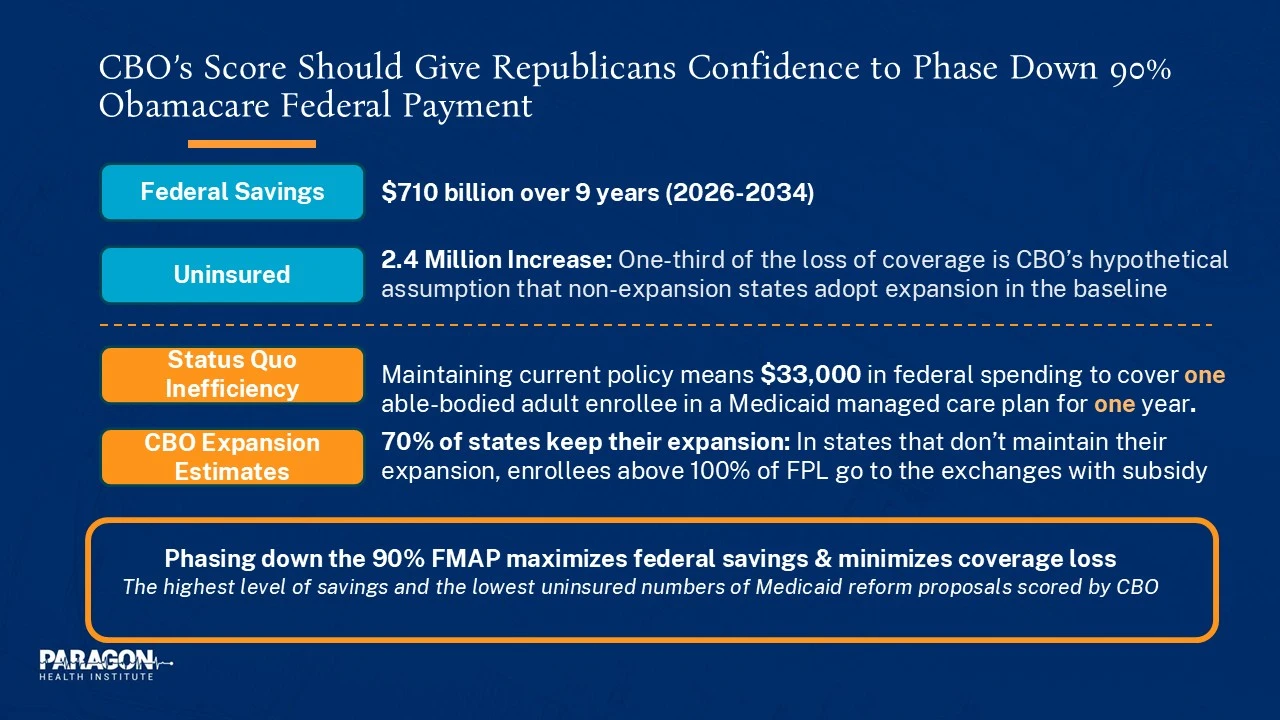
In May, the Congressional Budget Office estimated that 70% of expansion states would maintain their expansion if Congress adopted a policy to move the 90% expansion reimbursement to states’ normal reimbursements in October 2026.
Maintaining Current Policy Is Costly and Inefficient
According to CBO, lowering the 90% federal reimbursement to the normal state reimbursement would save $710 billion over nine years (2026-2034) and result in an increase of only 2.4 million uninsured individuals. And one-third of that coverage reduction reflects CBO’s assumption that non-expansion states adopt expansion in the baseline. The remaining coverage loss depends on state decisions on whether to keep able-bodied adults on the program if the federal match were the same as what states receive for children, pregnant women, the elderly, and the disabled. Maintaining current policy means the federal government spends $33,000 to cover one able-bodied, working-age adult enrollee in a Medicaid managed care plan for a single year.
Voters Strongly Support Equal Medicaid Funding for the Vulnerable
In a survey Paragon commissioned earlier this year, we asked voters this question: “Do you support or oppose Congress lowering the percentage that the federal government pays states for Medicaid costs for able-bodied, working-age adults to the same level it pays for pregnant women, children, and those with disabilities?” Nearly two-thirds of Americans responded that they support this policy.
Related Content

Subscribe
Sign up now for your health policy updates.